description

My own life and my opinions are shared at When I was 69.

REMEMBER: In North America, the month of September 1752 was exceptionally short, skipping 11 days, when the Gregorian Calendar was adapted from the old Julian one, which didn't have leap year days.
Showing posts with label Mary Sarah MacDougall MacKorda. Show all posts

Saturday, October 30, 2021

B & W Photos of yesteryear, and some histories


Mary McCloud Bethune was born on July 10, 1875

She started a school for African-American girls with $1.50. The school bordered the town dump. Make-shift desks and chairs were made from discarded crates and boxes. There were five students at the time, and the students made ink for pens from elderberry juice and pencils from burned wood.
When the the local Ku Klux Klan heard about the school, they threatened to burn it down. There were reports that they waited outside the school, but she stood in the doorway, unwilling to back down or leave her school. Other stories say that she and her students started singing spirituals. The Ku Klux Klan eventually left.
Mary McLeod Bethune was born on July 10, 1875 in a log cabin on a cotton farm in South Carolina, the 15th of 17 children of former slaves. Most of her brothers and sisters were born into slavery; she was the first child born free. She started working in the fields by the age of 5.
This is a post from the Peace Page, with information compiled from historical sources online. The Peace Page encourages readers to learn more of the life of Mary McLeod Bethune online.
One day, she accompanied her mother, delivering “white people’s” wash. When she was given permission to enter the white children's nursery, she saw a book, which fascinated her. A white girl would quickly snatch the book from her hands, telling her she didn't know how to read. That's when Mary realized the only difference between white and black folk was the ability to read and write.
When she got the opportunity, McLeod attended a one-room black schoolhouse, walking five miles to and from the school. When she got home, she would teach her parents and siblings what she learned. She then got an opportunity to attend the Moody Bible Institute in 1895, becoming the first African American student to graduate from the school.
She decided then she would become a missionary, sharing what she learned. But, she would be informed that no one wanted or needed a black missionary.
Rather than give up her dreams, she decided more than ever that she would eventually teach.
Flash forward to 1904, when after moving to Florida, she started the Educational and Industrial Training School for Negro Girls, which initially had five girls aged six to twelve. With limited resources, she was determined to make the school a success, even when the Ku Klux Klan threatened her. But, eventually she received donations and support from the community, and the school grew to 30 girls by the end of the year.
Booker T. Washington would tell her of the importance of white benefactors to fund her school, so she started traveling and fundraising, receiving donations from John D. Rockefeller and establishing contacts with Franklin and Eleanor Roosevelt.
Her little school would become even more successful after it merged with a private institute for African-American boys and became known as the Bethune-Cookman School. She was president of the college from 1923 to 1942, and 1946 to 1947, becoming one of the few women in the world to serve as a college president at that time.
After she found that one of her students needing medical care was denied the care she needed and was placed on an outside porch of the local white hospital instead of a room with a bed, she used her funding sources and connections to open the first black hospital in Daytona, Florida.
According to the Turning Point Suffragist Memorial Association, McLeod became "one of the 20th century’s most powerful and celebrated advocates for civil rights and suffrage", holding "prominent roles, including president, in the National Association of Colored Women (NACW). She also served as president of the Florida Federation of Colored Women’s Clubs, where she fought against school segregation and sought healthcare for black children. Under her leadership, the National Council of Negro Women (NCNW) was founded as a unifying voice for African American women’s organizations."
As chapter president of the Florida chapter of the National Association of Colored Women, she would become so well known for her work registering black voters that once again she received threats from the Ku Klux Klan. And, like before, she did not back down.
With her friendship with the Roosevelts, she would become appointed as a national adviser to president Roosevelt, becoming part of what was known as his Black Cabinet and advising him on concerns of black people and would be called the “First Lady of the Struggle”.
When she passed away on May 18, 1955, she was recognized across the country. One newspaper suggested "the story of her life should be taught to every school child for generations to come" and The New York Times noted she was, "one of the most potent factors in the growth of interracial goodwill in America."
In her own words before she died, she wrote:
"I leave you love. I leave you hope. I leave you the challenge of developing confidence in one another. I leave you a thirst for education. I leave you a respect for the use of power. I leave you faith. I leave you racial dignity. I leave you a desire to live harmoniously with your fellow men. I leave you a responsibility to our young people."
“If I have a legacy to leave my people, it is my philosophy of living and serving. I think I have spent my life well. I pray now that my philosophy may be helpful to those who share my vision of a world of Peace, Progress, Brotherhood, and Love.”
[Note: This was originally published on the Jon S. Randal Peace Page in 2019. You are welcome to share, but please do so via the Facebook share button which acknowledges the original author. Thank you.]

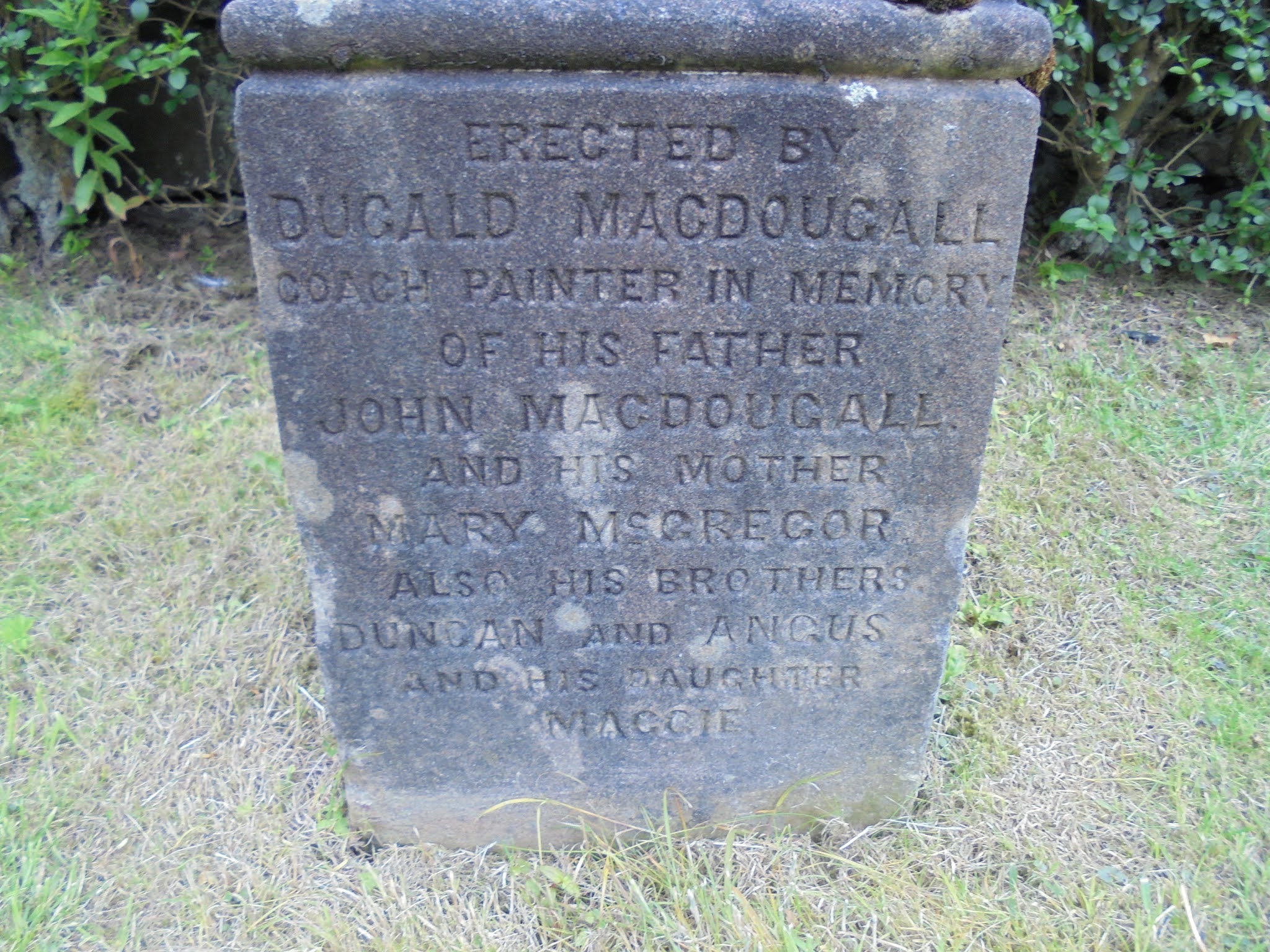
And as I've looked into my own ancestors' pasts...I found that I've a drop or two of Scottish blood...namely from Dugald and John MacDougall

This carving is the base of the memorial depicted below, out of focus.


In my Ancestry tree, WIlliam McElhany (1766-1815) of Pennsylvania, fought in the War of 1812, on the American side.

His memorial is in the Cheektowaga Historical Cemetery site. I posted about the cemetery before HERE..

Soldiers who died in the military hospital were buried in the cemetery on Aero Dr. which was located in Amherst until the New York State Thruway was built nearly 150 years later, when the cemetery became part of the Town of Cheektowaga.

Graves are not individuality marked, there are small white wooden cross's scattered throughout the cemetery.

Established: 1814 - 1815, aka Old Military Cemetery, aka Garrison Road Cemetery, aka Creek Road Cemetery .

Denomination: Military

Address & Location: Located on the south side of Aero Rd., between Transit Rd. and Wehrle Dr., west of Youngs Rd. (North of Buffalo International Airport). 

William McElhany's wife was Elizabeth Clark McNeal McElhany (1768-1849) and her ancestors included members of the families McNeal, McKorda, McKinney, and many a Scotch-Irish family.

One grandmother was Mary Sarah MacDougall, 1664-1725...who's lineage included MacLaughlin, Livingstone, Gillespie and her father, Alexander MacDougall.  He was the 21st Chief of Dunollie and of Lorn, (1635-1695) of Dunollich, Argyllshire, Scotland. He would be my 9th great grandfather.

I'm not quite sure how the monument connects to him...and will try to figure that out in the next few ventures into Ancestry. I know only that she was my 8 time great grandmother, among the immigrants from Scotland to Ireland.

In the meantime I wanted to share two serious looking ladies, all squeezed up in their fine attire, ready to walk somewhere with beautiful parasols.  I don't think I'm related, and don't even know their names.

Sharing with Sepia Saturday this week!


Today's quote:

“It is not work that kills men; it is worry. Work is healthy; you can hardly put more upon a man than he can bear. Worry is the rust upon the blade. It is not the movement that destroys the machinery but the friction.” ~ Henry Ward Beecher


Friday, December 15, 2017

More McCord Ancestry notes

And notes from McCord Ancestry sites:
JOHN DUNCAN MCCORD
John, was born about 1660, and was in the siege of Derry (now Londonderry, Northern Ireland) with King William's men in 1689, and was in many other battles. John's wife was Mary McDougal. John became clan chieftan at the death of his father. They moved to Ireland about 1688 as part of the great Ulster Plantation, when Scots and Englishmen were sent to oust Irish landowners. These McCords settled in Stewartstown, CountyTyrone. "
JOHN DUNCAN MACKORDA
JOHN TOOK OVER THE CLAN CHIEFTAN AFTER THE DEATH OF HIS FATHER, JAMES MACKORDE. JOHN FOUGHT IN MANY WARS BEFORE HIS OWN DEATH. EMIGRATED TO COUNTY TYRONE ULSTER PROVINCE IRELAND WITH HIS SEVEN SONS.
THEY SEEMED TO CHANGE THE SPELLING OF MACKORDE TO MACCORDE AROUND 1705.
ANOTHER VERSION COMES FROM AN OLD MCCORD NOTEBOOK WRITTEN BY A T. J. MCCORD FROM SPLIT LOG,MO. (SOMETIME IN THE 1800s) IT STATES THAT JOHN DUNCAN DIED IN 1715 AND IT WAS THEN THAT  HIS SEVEN SONS MOVED TO IRELAND AND DROPPED THE "A" FROM MACCORD AND CHANGED IT TO MCCORD.
They moved to Ireland after 1689,  Stewartstown, County Tyrone, Ireland shortly after the Battle of Killiecrankie (1689), John (McCord, son of James McCord of the Isle of Skye) and his wife, (along) with his infant brother James McCord, left Scotland, settling in Stewartstown, County Tyrone, Ireland, where, it is said, they had relatives.
About John
 After his father was killed in the Battle of Killiecrankie in Scotland in 1689, John took the rest of the clan and moved them to Ulster in Northern Ireland. They lived here until about 1740, when they came to America.
Dundee's Rising in Scotland
On 16 April 1689 John Graham of Claverhouse, Viscount Dundee, raised James' standard on the hilltop of Dundee Lawwith fewer than 50 men in support. Although Presbyterian historians later labelled him "Bluidy Clavers" for his vicious persecution of Covenanters, he has also been called "Bonnie Dundee". (This was from a song written by SirWalter Scott in 1830.) James had already arrived in Ireland and his letter was on the way promising Irish troops to assist the rising in Scotland.
At first Viscount Dundee had difficulty in raising many supporters. The ineffectiveness of the Williamite commander Major-General Hugh Mackay of Scourie encouraged support. Two hundred Irish troops successfully landed at Kintyre to add to Dundee's forces. Dundee also received support in the western Scottish Highlands from both Roman Catholic and Church of Scotland clans.
By July the Jacobites had eight battalions and two companies, almost all Highlanders. Dundee gained the confidence of the clans by cultivating the allegiance of each Highlander and respecting the precedence of the clans. He realized that to them, the cause of Jacobitism was secondary. At a time when infantry were trained to fight in formation, the Highlanders' method was more informal. They set aside their plaids and other encumbrances before the battle, and dropped to the ground to avoid enemy volleys. After quickly returning fire, they pursued their foes, screaming in the Highland charge. They used heavy broadswords and targe (shield), or whatever weapons they had, including pitchforks or Lochaber axes(a combined axe and spear on a long pole). Such a charge was devastating to troops struggling to reform their lines, or fix the recently introduced 'plug' bayonets.
The Highland charge (and troop strength) defeated a larger lowland Scots force at the Battle of Killiecrankieon 27 July 1689. About one-third of the Highlanders were killed in the fighting, and Dundee died in the battle. At the street fighting of the Battle of Dunkeld on 21 August, the Jacobite Highlanders were decisively defeated by the Cameronians. Much of the North remained hostile to the English government. Expeditions to subdue the highlands were met with a series of skirmishes.
notes taken from McCord sites. 7/13/2010

Much of this information above is covered in Michael McCord's 1996 book, The McCord Saga.  In it he goes generation by generation,  using as source LDS information often, with many "unknown" wives and children listed.  But my ancestor John McCord, born around 1702 is included as a son of John Duncan MacCord or MacKorda (BIRTH 1660 • Argyle, , Skye, Scotland, DEATH 1715 • Stewartstown, Tyrone,  Ireland) and his wife Mary MacDougall.  John is their fourth son, with William, James and Benjamin being older.
This book is quoted HERE at Family Tree Maker.
Here's what is said about John McCord:
6. JOHN4 MCCORD (JOHN DUNCAN3 MACCORDE, JAMES DUNCAN2 MACKORDA, JOHN1) (Source: McCord Family Assoc. Web Page.) 
was born Abt. 1702 in Ireland or Scotland, and died 1762 in Paxton, near Derry, PA.
He married UNKNOWN.   More About JOHN MCCORD:
Church: 1733, Spring Creek Presbyterian Church in Derry, PA (now Hershey, PA)

Emigration: 1720, from Ireland (family originally from Scotland)

Settled: Aft. 1720, Hanover Co., PA (which was originally in Lancaster Co., PA)


I like hearing there's a McCord Family Assoc. Web Page...but I don't know where it is.

So my ancestor, John is first generation in America, and was born either in Ireland or Scotland (as just mentioned above, but not in my ancestry tree.)  His father James Duncan McCord had changed his name from MacKorda when moving to Ireland.  
Now Ancestry has added enough information that I see the next generation back gives a title of Sir James Duncan MacKorda, Clan Chief.  He's the one who died at the battle.  But there seems to be a little information that his father had been a John MacKorda, born around 1600 in Argyle, Isle Skye, Scotland, where he died in unknown year.  His wife was Mary Allison (1602-?_)
Now James MacKorda married Mary Sarah MacDougall of the clan MacDugall (22 FEB 1664 • Argyle, , Skye, Scotland - 1725) Here's a portrait of someone in the tartan of that clan...perhpas Mary Sarah, perhaps not.

I must stop this never ending search for the next believable ancestor.  

Today's quote:


No matter how brave, strong, or levelheaded we are, sometimes we all get scared.