description

My own life and my opinions are shared at When I was 69.

REMEMBER: In North America, the month of September 1752 was exceptionally short, skipping 11 days, when the Gregorian Calendar was adapted from the old Julian one, which didn't have leap year days.
Showing posts with label ancestors. Show all posts

Saturday, May 10, 2025

My ancestor mothers

  How many mothers might you know about in your ancestry?

I had a few dead ends, because there were often few documents of just whoever Joe Smith married named unfortunately Mary or Susan. These women raised a family, and cared for at least one of my direct ancestors. But their own mothers remained a mystery.

So I'm getting out my trusty Ancestry app, where I think I've got about 8000 people on my main tree (yes I've got a few off shoots also, which add about 3000 more potential relatives.)

My main tree has almost 4000 photos as well. 

Let's just find some sepia mothers to share today.


My grandmother on the left with her sister.

1. Ada Phillips Swasey Rogers (my father's mother) (1886-1964)


2. Ada's mother, Zulieka Granger Phillips Swasey (Dear Nan)  (1858-1935)

Dear Nan with her granddaughter, Ada Mary Rogers


3.Dear Nan/Zulieka's mother, Mary Hull Granger Phillips,  (1829-1861)


A woman's portrait, unknown, but showing hair style and clothes worn in the 1820s.

The following are my transcriptions from copies of original letters that were written by Mary Granger Phillips:

(No notation of date or place;  MaryPhillips.001 and 002)

 There is plenty of Game in the woods but William has had little time for hunting now.  Does are rather scarse. (sic) The Black tong(?? Two letters added above word, unclear) killed a great many off last year they say.

        I have not got my Piano yet – waiting for a draft on P.O. as I think I can be better suited by sending there for it.

        I must remind you will wirte me as I am anxious to hear how you are this cold Winter.  I almost feel as if I had got back to the North.  Do you remember of ever experiencing such cold weather any Winter before?

        Lizzie writes me Mother has suffered a great deal with the Asthma, It is impossible for her to endure the cold.

 ===(on back page)

I receive the Harpers and regret I did not take the Ladys also (perhaps publications?)  I find many people even away up here (Monde?) who know you and ask with no little interst after you.

        The river is rising very fast today and we are listening for a Seamboat every moment.  There are some seven or eight flat-boats on their way down with Cotton.  Hoping to hear from you soon, I close,

                Yours affectionately,

                        Mary H. Phillips

 ------

(note by author: Lizzie is her sister, Elizabeth Granger, and Mother is probably Mary Granger. The piano arrived, according to a letter posted on_ June 10th, 1860)
(no heading, written to her Mother-in-law, Mary Gainer, see MaryPhillips.002)

 The children are quite well.  Zulie often talks of you all.  She is growing very fast and talks us nearly crazy.  Is very curious must know and understand every thing she hears and sees.  She is pretty, bad and smart and I am I regret to say entirely unable to control her never having seen ever such a temper.  I often wonder how Lizzie would manage her, although Zulie has been much spoiled (--?--) everyone, she is very affectionate, child loves me dearly  but does not want to mind.  Ada is different more mild the sweetest and caring little thing will let you kiss her all day and not get mad.  Pa Gainer says Zulie is the worst child he ever saw and Ada the best now if they do not spoil her.  She began to walk a little past nine months it is so cunning to see her walking her hair curls and she goes round

 (on back page)

jabbering to herself you all would eat her up.  I have not had a pair of shoes to fit her since those you sent and they are all worn out.  I have let her go barefooted this Summer on account of not being able to get any for her.  I do hope some goods will come to Town Bluff.  Zulie too wears anything for shoes.  I am very much troubled about getting everything.  There are no goods any near us.  I expect we shall see sights to get things to wear this Winter.  I think you will find a letter of winds if nothing else.  I will try to write often as I can.  I have on hand a monstrous pile of sewing though, but will answer all who write.  All desire Love keep a cheerful heart dear Mother. I think of you much and often.

        Your affectionate Daughter,

                        Mary

 (Author’s notes: Pa Gainer (William Phillips step-father) is in Texas, or has been to have seen both granddaughters.  His words are being relayed either to his wife, Mother Gainer, or Mary's mother, Mary Granger, by Mary.  The time may be after Confederate blockade has made goods hard to obtain.  Ada had been born Sept 15, 1860, so would be 9 mos old by June of 1861)  But the blockade wasn’t really holding manufactured goods back entirely. Perhaps goods just weren’t being shipped at this time, except for war needs.)


4. Mary's mother, Lucy Elizabeth Parsons Pulsifer,  (1807-1876) (I have yet to find out who/why the Parsons name is included for her.) See below about her earlier sister and brothers. Incidentally, she apparently died in Galveston TX in 1876 (according to a news record and a probate in 1877 in Massachusetts). Yet she, as Lucia, and an unmarried daughter, Elizabeth Granger appear on the 1880 census in Southwick, Hampton, Massachusetts. That is another one I haven't figured out yet. Her real daughter Elizabeth married and had 3 children, and continued living in Galveston. Who was this other Elizabeth and mother Lucia?

Incidentally, her brother, Joseph Perkins Pulsifer was one of the founders of Beaumont TX. Here's a bit of information about him:

PULSIFER, JOSEPH PERKINS (1805–1861). Joseph P. Pulsifer, early Texas apothecary and a founder of Beaumont, the son of Ebenezer and Elizabeth (Dwelbee) Pulsifer, was born in Newburyport, Massachusetts, on July 8, 1805. Little is known about Pulsifer's education, except that his letters show him to have been an extremely literate man. Probably through apprenticeship, he became an apothecary, and sometime after 1827 he opened a drugstore in partnership with his brother Eben in nearby Charlestown, now a suburb of Boston. There Pulsifer became a member of the Mechanics' Society and served as its secretary in 1831. Sometime during 1832 or 1833 he returned to Newburyport to work in the drug firm of Thomas Davis and Company. In the fall of 1833 Pulsifer moved to New Orleans in search of economic opportunity and found employment in the store of druggist and retail merchant Henry W. Millard . By 1835, however, the firm developed financial troubles. Pulsifer and Millard then entered into a partnership, J. P. Pulsifer and Company, with Texas merchant Thomas B. Huling . The men moved to Texas in July of that year. In a small settlement named Santa Anna, on the Neches River, they opened a store under Pulsifer's management. In the fall of 1835 the firm purchased fifty acres on the Neches River and laid out the boundaries of a new town, which they called Beaumont.

 From Beaumont, Pulsifer took an active, if nonmilitary, part in the Texas Revolution . Citizens of the Neches River Settlement, as that area was called, appointed him chairman of the Committee of Correspondence, secretary of the Committee of Safety, and a member of a local committee to draft ideas for a constitution and bylaws for Texas. He also served as Beaumont's first postmaster and as a trustee of the first school. After the revolution Pulsifer, Huling, and Millard added fifty acres to the original Beaumont townsite. By entering into partnership with Nancy Tevis and Joseph Grigsby , each of whom donated an additional fifty acres, they increased the original area of the town to a total of 200 acres. Beaumont ultimately incorporated both Santa Anna and Tevis Bluff, an older settlement about a mile upriver from Santa Anna. Pulsifer, who never married, remained a citizen of Beaumont for the rest of his life. In addition to practicing his professions of storekeeper and apothecary, he served in various public offices: collector of revenue for the port of Sabine, county clerk, county commissioner, and clerk of the Jefferson County Board of Land Commissioners. Before the first Jefferson County Courthouse was built in 1854, the county commissioners periodically held court on the second floor of his combination home and store in Beaumont. He also served as an agent in Jefferson County for the Austin State Gazette . Pulsifer died in Beaumont in 1861. The one extant volume of his correspondence remains unpublished. It covers the period from 1833 to 1836 and describes his immigration to Texas and his ordeal during the Texas Revolution.

 BIBLIOGRAPHY: 

 Judith Walker Linsley and Ellen Walker Rienstra, Beaumont: A Chronicle of Promise (Woodland Hills, California: Windsor, 1982).

 Source: Texas History Online


5.  Lucy's mother, Elizabeeth (Betsy) Dwelle Pulsifer (and similar spellings)(1762 or 72 - 1824) Betsy had her first three children die quite young. So they named later children the same names. Joseph the first died at 9 months in 1798. Elizabeth had her death noted as May 28, 1800, but no birth record. And Ebeneezer the first just lived from July 1801 to April 20, 1806.


6. Betsy's mother, Elizabeth Browne Dwelly (or similar spellings)  (1737 or 1740 - abt.1768) 


7. Elizabeth's mother, Abigail Goodenow Browne,  (1716-1803)


8. Abigail's mother, Prudence Morrison Goodenow/Goodnew,  (1691-1720)


And we know no further along that maternal line... though there were mothers of each of the fathers which would mean about a hundred or so more mothers just from my one grandmother's line!

Prudence was my seven times great grandmother. 


Sharing with Sepia Saturday where I'm completely off the meme this week. But we'll get by, and share my Mother's Day eve post with my sepia friends!


Today's Quote:

Maya Angelou


Monday, March 17, 2025

Erin go Bragh

 Duplicate post today from "When I was 69" because it looks at my ancestors from Ireland...maybe

-------------

 For St. Patrick's Day...from an area with a few Irish descendants, in western North Carolina.

Have a happy St. Paddy's Day all! Raise a glass of green beer to cheer everyone for a good new year ahead. May all experience peace, abundance, good health, love and joy!


SlĂ inte ! To your health!

And for the non-alcoholic among us, the same wishes apply!


A shamrock blooms in my window on my desk, but it's a ruddy version, so doesn't remind one of the Isle of Green! 

My roots include the Scotch-Irish, which means some ancestors were born in Ireland, though they had been immigrants from Scotland. 

One ancestor is:

John Francis Beattie II, (1718-1790) b. 1718 Killishandra, Cavan County, Ireland, d. 18 Aug 1790 Emory, Washington County, Virginia

Another descendant attached this coat of arms to his page in Ancestry. (yes a tiny file and there're no details about it.)


And the more I look into his life story on Ancestry, the more confused I got. A will written by one John Beattie says his wife is Margared, and he had 8 children which are named. He died in Virginia.

Another John Beattie lived in New York.

And there were 3 different wives names given, Ellen or Eleanor, Martha, and Margaret/Margared.

My ancestress, Margaret Beattie (1762-1861) married a man named Rev. Thomas "Junior" Hansford (1758-1841). They were both born in Virginia and married there in 1788. There are 13 children listed, but some duplicate names with different birth dates...so they may actually be the same persons.

Right after their marriage they moved to the frontier of Kentucky, where they raised all their children and are the Hansford parents buried in Crab Orchard KY. 

So whatever the connection to Ireland may be, these are some American documented ancestors. I can sometime go through all the siblings of my direct line and sort out who was duplicated, but that's for another day.

Today (Wednesday March 12 while I'm writing this) is warm again and I'm going to enjoy some of the green shoots that are finally showing after the greys of winter.

Happy St. Patrick's Day if you celebrate, with or without any Irish roots.

Many large cities have a parade!


Tuesday, September 24, 2024

The Language You Cry In

  A story of ancestors...thanks to Facebook's Suppressed Histories

The Language You Cry In


This amazing 1998 documentary shows how the Gullah descendants of Mende people from Sierra Leone preserved an old mourning song in the Georgia Sea Islands, in their ancestral language, though they no longer understood the words or the meaning.
In Harris Neck, in Georgia's coastal islands, in the 1930s, Lorenzo D. Turner recorded a 50-year-old woman singing. Her song preserved the longest known text in an African language in the North American diaspora. It was later recognized as Mende by a grad student from Sierra Leone, on the basis of a single word, kambei, which had funerary significance, and he published a translation of the song.
The singer's grandmother had been born into slavery, a descendant of many West Africans trafficked to Georgia because of their expertise in rice cultivation. Slave traders paid a higher price for people with this skill, shipping captives from the rice-growing countries from Senegambia to Sierra Leone and Liberia. More than 45% of those trafficked to Savannah were taken from Sierra Leone, out of Bunce Island which was used as a holding area prior to the Middle Passage. The channels these Mende people dug for rice plantations still remain in Georgia.
A group of Gullahs returned to Sierra Leone, and performed this melody for their African hosts. They discovered that one word, tombei, could be traced to a specific place. Anthropologists took recordings of the song around that region, and at first people recognized one or two words, but not the song. The researchers finally gave up, disappointed. Later, Cynthia Schmidt decided to try one more place, just outside the boundaries of the area they had searched in. To her amazement, people began to sing the song, which included the words “Everybody come together, the grave is restless, the grave is not yet at peace.” (starting around 15:25 in the video at link)
This was a song that Mende women sang at burials, in a funerary rites called Tenjami, Cross the Water. Bendu Jabati describes how her grandmother taught her how to perform the mourning rites, kneeling and making gestures to the ground with outstretched hands. (And it seems that the grandmother foresaw that her descendant would be the one to preserve this knowledge, and the connection that it would make to distant kin.)
The ceremony began with a call to the ancestors to accept the dead person. The women went in procession, their faces painted with white clay, dancing while bent over. They then cooked at the grave side (three days after a woman’s death, and four days after a man’s). They performed ritual crying and lamentation at the grave, and bid farewell with rice mixed with palm oil and meat. The ceremony ended when the pot was upturned over the grave, the final farewell.
The ceremony lapsed after World War II, according to the narrator, when soldiers brought back Islam and Christianity; but this one woman Bendu Jabati had been charged to remember by her grandmother, and she kept the knowledge and the song alive.
Back in the Georgia Sea Islands, Amelia Dawley taught this song to her daughter. Living in a remote area, without TV or radio, she was able to preserve it. (Hear her sing it around 26:00 in the video) The anthropologists visit and play the recording of her grandmother, telling her of the historical importance of her family legacy, in its connection to African roots.
Thanks to Hannah Ekberg for this link.
Source: Suppressed Histories Archives Facebook page


Friday, August 30, 2024

On the roads to new horizons


  I found this article from "Our State Magazine" in my "memories" folder on FaceBook. But it didn't include the "share" button. so I re-read the article, and wanted to be sure to share it somewhere, and hope to have it in my own archives here on Blogger. And if I shared it before (quite possibly) mea culpa!

Ramblin Man

The link still works for now at least.


My interest (as always) is in considering my ancestors who might have used these (or similar) roads.


In 1775, Daniel Boone "blazed" a trail for the Transylvania Company from Fort Chiswell in Virginia through the Cumberland Gap into central Kentucky. It was later lengthened, following Native American trails, to reach the Falls of the Ohio at Louisville. The Wilderness Road was steep, rough, narrow, and it could only be traversed on foot or horseback. Despite the adverse conditions, thousands of people used it.

Daniel Boone coming through Cumberland Gap by George Caleb Bingham


I've written about the Cumberland Gap, and my family's travels on the roads leading into Kentucky HERE.


The Williams family in Oklalla TX (maybe not related to my family) 1889

And here is a clip about an ancestress that lived into her 90s, who moved into Kentucky before it became a state. Here.


-------------------------

And a bit of Mary Oliver, just because...

"I thought the earth remembered me, she took me back so tenderly, arranging her dark skirts, her pockets full of lichens and seeds.

I slept as never before, a stone on the river bed,

nothing between me and the white fire of the stars
but my thoughts, and they floated light as moths
among the branches of the perfect trees.

All night I heard the small kingdoms breathing around me, the insects, and the birds who do their work in the darkness.

All night I rose and fell, as if in water, grappling with a luminous doom. By morning
I had vanished at least a dozen times into something better."

~Mary Oliver, "Sleeping in the Forest"


Sharing with  Sepia Saturday 


Thursday, October 12, 2023

Great many times grandfather of my son Russell Heym

repost from Aug 16, 2014 

When I was 69 blog

-----------------------------

Aaron John Rogers, born 1265 in Rome, Roma, Lazio, Italy,  died 1356 in Somerset England.  I posted about him HERE before.


And this is the furthest back that the Rogers genealogy goes at this point...or maybe there was another count who lived in Naples.  Mmm, that must have been on a different tree.

Anyway, whether or not this grandfather is truly yours or not, have a great birthday this 16th of August.  I know you're my son, and am so proud of you.  I've loved you since the day you were born!

I think what is remarkable about the Rogers tree is that all these men had a son...until my generation.
And of course you've done the same thing my dad did, had only daughters.  But then, your mom (me) changed her name back to Rogers after her divorce, and apparently a couple of my female cousins also still have the Rogers name.  So what's in a name?

I'll only post one picture of you this year...since I posted so many last year HERE. 

Now which one do I want to post, hummmm...how about this one?

ss

A Taco for 49 cents, and Tai was much shorter than you were, just before we left Altanta for Cumberland Island vacation trip...mid 80s.  It was great fun with you and Tai on several summer camping trips.  Now you both have your own summer vacations...outdoors too!

Have a very happy birthday, son.

Earliest ancestor

 repost from When I Was 69


Wednesday, June 25, 2014

The earliest ancestor

Well, Adam and Eve (or Lilith perhaps) might be on my tree somewhere.  With the new DNA searches, friends have followed their mitochondrial markers in various ways through tribes of ancestors.

I searched through some local cemeteries for the oldest person buried there.

In AncestryDOT com I've found the earliest ancestor on my father's Rogers line.  

It's Aaron John Roger, Birth 1265 in Rome, Roma, Lazio, Italy. Death 1356 in Somerset, England

I have no clue as to who found his data, or how these details of his life survived, not to mention those of his descendents.

Isn't this fun?  His wife's family was from Holland too, at least by the name.  
Elizabeth DeHoland, Birth 1270 in Italy.
  Death 1335 in Bodmin, Cornwall, England

And they both died in England...in different counties.  I'm also struck that he outlived his wife by 20 years or so.  Just a bit unusual. And he certainly was long lived!
 
Since I've never been to England, I wonder if any of my friendly bloggers can clue me in on any more information.
14th century Somerset or Bodmin, Cornwall?
 
I did find a mention of a ruined chapel next to the big church in Bodmin, so that chapel probably was around when my ancestress died in the vicinity.
 
Chapel of St. Thomas a Beckett, Bodmin, Cornwall, England

Friday, November 4, 2022

November noteables

 When looking at my calendar, I find dates of many ancestors appearing.

This is a screwy kind of way to look at them, as they usually stay within their two dates (with a dash in between) and with their immediate families, like on my Ancestry tree.

But hey, I've got them appearing all the time, as I've listed their important birth dates (and a few others) in my personal calendar.

Nov 1

Frederick Arthur Munhall Birth 1 November 1890  in Pekin, Tazewell, Illinois, Death Feb. 12, 1927 in San Anntonio, Bexar Texas, USA

My mom's stepfather from age 2- age 10,


Nov 4 , Ebenezer Pulsifer, Birth 4 NOV 1744 Ipswich, Essex, Massachusetts, Death 1795 • New York, NY.

h. of Sarah Perkins, date unknown birth ABT 1757 Ipswich, Essex Co., MA, death date unknown,

parents of Capt Ebenezer Pulsifer, 3rd g grand of Ada Phillips Swasey Rogers, my grandmother on my father's side.

Nov 4 also: Martha Poor Granger, Birth 4 NOVEMBER 1654 Andover, Essex, MA, Death 4 DECEMBER 1723 Andover, Essex, MA

my 5th g grand on my father's mother's line

Nov. 9, George Elmore Rogers, JR, b. 1914 Galveston TX, d. 5 Jan 1985, Houston TX.

my father.

Nov 10, John Moss Jrm Birth 10 NOVEMBER 1682 Wallingford, New Haven County, Connecticut, Death 14 MARCH 1755 Wallingford, New Haven County, Conn

m. Eliz. Hall 1690-1754

father of John Moss

grandfather of Eliz Moss Booth

in my mother's ancestry line of the Booths

Nov 11, Patricia Rogers 1946

my firrst cousin, daughter of James W. Rogers, my father's brother

Nov. 13, Remembering Ammi Ayers Swasey 1687–1783 Birth 1687 either in Portsmouth, Rockingham, New Hampshire or Boston, MA,

Death 1783 Swansea, Bristol, Mass

When she was born on an unknown date in 1687, her father, NATHANIEL, was 23, and her mother, AMY, was 32. Nathaniel was known as a blacksmith, which is kept in the Ancestry records.

Ammi married Samuel Swasey Jan 10, 1710 as recorded in Boston, MA when she was 23. They had six children in 22 years. She died in 1783 as recorded in Swansea, Massachusetts, at the impressive age of 96. She spent almost half her life as a widow, since Samuel had died in 1739.

Her home was featured in a later photograph, though since then it has been demolished.

Ammi Ayers Swasey was my 6th great grandmother on my grandmother Ada Phillips Swasey Rogers' tree.

Nov. 14, Elizabeth Anne Worsham Kennon, Birth 1656 Henrico County, Virginia, Death 1743 • Conjurers Neck, Henrico, Virginia

w of Col. Richard Kennon, on my Rogers family tree

blog on 11.12.2020, Link Here.

I'll check back on more birthdays this month later!


Saturday, October 30, 2021

B & W Photos of yesteryear, and some histories


Mary McCloud Bethune was born on July 10, 1875

She started a school for African-American girls with $1.50. The school bordered the town dump. Make-shift desks and chairs were made from discarded crates and boxes. There were five students at the time, and the students made ink for pens from elderberry juice and pencils from burned wood.
When the the local Ku Klux Klan heard about the school, they threatened to burn it down. There were reports that they waited outside the school, but she stood in the doorway, unwilling to back down or leave her school. Other stories say that she and her students started singing spirituals. The Ku Klux Klan eventually left.
Mary McLeod Bethune was born on July 10, 1875 in a log cabin on a cotton farm in South Carolina, the 15th of 17 children of former slaves. Most of her brothers and sisters were born into slavery; she was the first child born free. She started working in the fields by the age of 5.
This is a post from the Peace Page, with information compiled from historical sources online. The Peace Page encourages readers to learn more of the life of Mary McLeod Bethune online.
One day, she accompanied her mother, delivering “white people’s” wash. When she was given permission to enter the white children's nursery, she saw a book, which fascinated her. A white girl would quickly snatch the book from her hands, telling her she didn't know how to read. That's when Mary realized the only difference between white and black folk was the ability to read and write.
When she got the opportunity, McLeod attended a one-room black schoolhouse, walking five miles to and from the school. When she got home, she would teach her parents and siblings what she learned. She then got an opportunity to attend the Moody Bible Institute in 1895, becoming the first African American student to graduate from the school.
She decided then she would become a missionary, sharing what she learned. But, she would be informed that no one wanted or needed a black missionary.
Rather than give up her dreams, she decided more than ever that she would eventually teach.
Flash forward to 1904, when after moving to Florida, she started the Educational and Industrial Training School for Negro Girls, which initially had five girls aged six to twelve. With limited resources, she was determined to make the school a success, even when the Ku Klux Klan threatened her. But, eventually she received donations and support from the community, and the school grew to 30 girls by the end of the year.
Booker T. Washington would tell her of the importance of white benefactors to fund her school, so she started traveling and fundraising, receiving donations from John D. Rockefeller and establishing contacts with Franklin and Eleanor Roosevelt.
Her little school would become even more successful after it merged with a private institute for African-American boys and became known as the Bethune-Cookman School. She was president of the college from 1923 to 1942, and 1946 to 1947, becoming one of the few women in the world to serve as a college president at that time.
After she found that one of her students needing medical care was denied the care she needed and was placed on an outside porch of the local white hospital instead of a room with a bed, she used her funding sources and connections to open the first black hospital in Daytona, Florida.
According to the Turning Point Suffragist Memorial Association, McLeod became "one of the 20th century’s most powerful and celebrated advocates for civil rights and suffrage", holding "prominent roles, including president, in the National Association of Colored Women (NACW). She also served as president of the Florida Federation of Colored Women’s Clubs, where she fought against school segregation and sought healthcare for black children. Under her leadership, the National Council of Negro Women (NCNW) was founded as a unifying voice for African American women’s organizations."
As chapter president of the Florida chapter of the National Association of Colored Women, she would become so well known for her work registering black voters that once again she received threats from the Ku Klux Klan. And, like before, she did not back down.
With her friendship with the Roosevelts, she would become appointed as a national adviser to president Roosevelt, becoming part of what was known as his Black Cabinet and advising him on concerns of black people and would be called the “First Lady of the Struggle”.
When she passed away on May 18, 1955, she was recognized across the country. One newspaper suggested "the story of her life should be taught to every school child for generations to come" and The New York Times noted she was, "one of the most potent factors in the growth of interracial goodwill in America."
In her own words before she died, she wrote:
"I leave you love. I leave you hope. I leave you the challenge of developing confidence in one another. I leave you a thirst for education. I leave you a respect for the use of power. I leave you faith. I leave you racial dignity. I leave you a desire to live harmoniously with your fellow men. I leave you a responsibility to our young people."
“If I have a legacy to leave my people, it is my philosophy of living and serving. I think I have spent my life well. I pray now that my philosophy may be helpful to those who share my vision of a world of Peace, Progress, Brotherhood, and Love.”
[Note: This was originally published on the Jon S. Randal Peace Page in 2019. You are welcome to share, but please do so via the Facebook share button which acknowledges the original author. Thank you.]

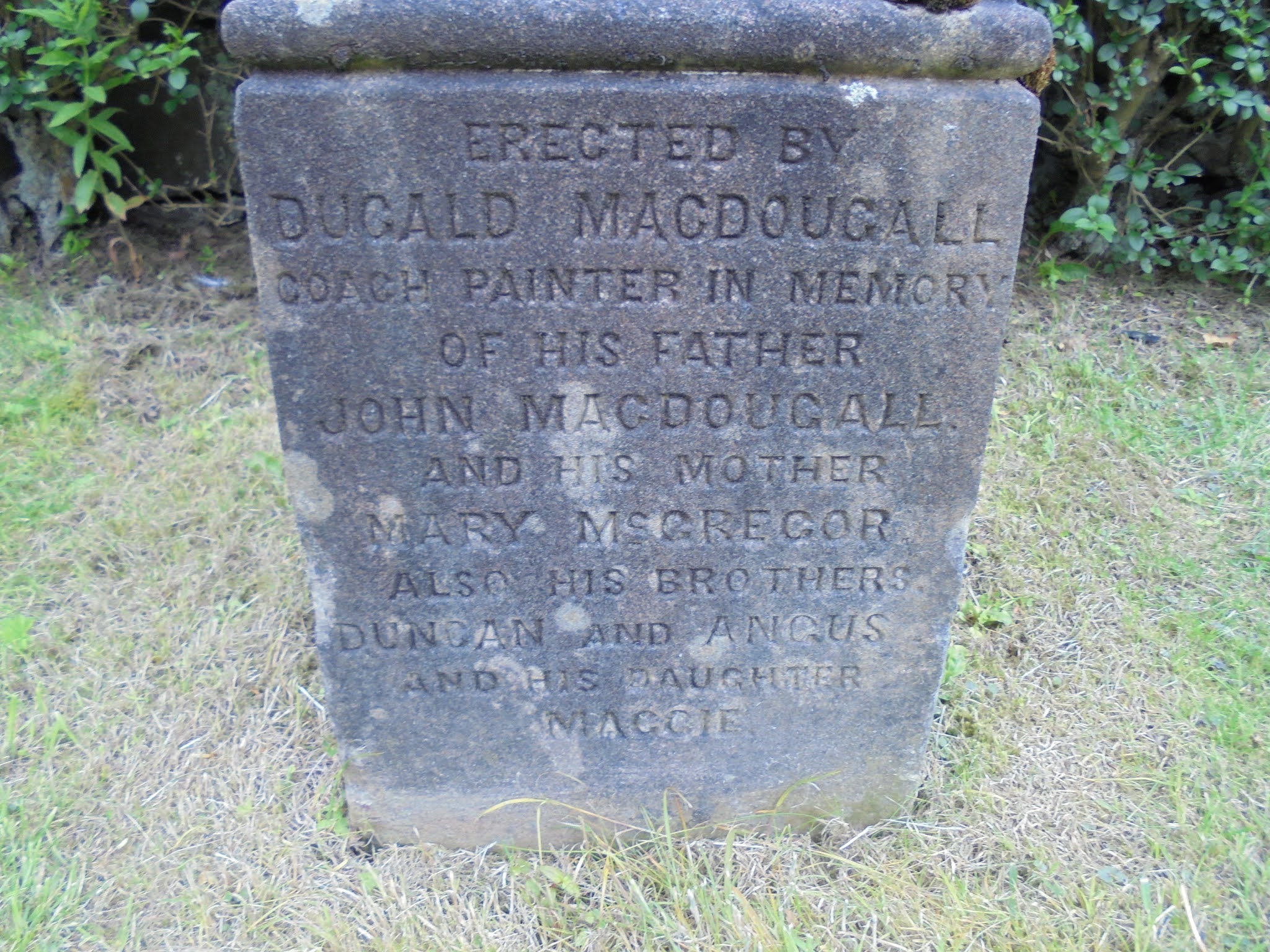
And as I've looked into my own ancestors' pasts...I found that I've a drop or two of Scottish blood...namely from Dugald and John MacDougall

This carving is the base of the memorial depicted below, out of focus.


In my Ancestry tree, WIlliam McElhany (1766-1815) of Pennsylvania, fought in the War of 1812, on the American side.

His memorial is in the Cheektowaga Historical Cemetery site. I posted about the cemetery before HERE..

Soldiers who died in the military hospital were buried in the cemetery on Aero Dr. which was located in Amherst until the New York State Thruway was built nearly 150 years later, when the cemetery became part of the Town of Cheektowaga.

Graves are not individuality marked, there are small white wooden cross's scattered throughout the cemetery.

Established: 1814 - 1815, aka Old Military Cemetery, aka Garrison Road Cemetery, aka Creek Road Cemetery .

Denomination: Military

Address & Location: Located on the south side of Aero Rd., between Transit Rd. and Wehrle Dr., west of Youngs Rd. (North of Buffalo International Airport). 

William McElhany's wife was Elizabeth Clark McNeal McElhany (1768-1849) and her ancestors included members of the families McNeal, McKorda, McKinney, and many a Scotch-Irish family.

One grandmother was Mary Sarah MacDougall, 1664-1725...who's lineage included MacLaughlin, Livingstone, Gillespie and her father, Alexander MacDougall.  He was the 21st Chief of Dunollie and of Lorn, (1635-1695) of Dunollich, Argyllshire, Scotland. He would be my 9th great grandfather.

I'm not quite sure how the monument connects to him...and will try to figure that out in the next few ventures into Ancestry. I know only that she was my 8 time great grandmother, among the immigrants from Scotland to Ireland.

In the meantime I wanted to share two serious looking ladies, all squeezed up in their fine attire, ready to walk somewhere with beautiful parasols.  I don't think I'm related, and don't even know their names.

Sharing with Sepia Saturday this week!


Today's quote:

“It is not work that kills men; it is worry. Work is healthy; you can hardly put more upon a man than he can bear. Worry is the rust upon the blade. It is not the movement that destroys the machinery but the friction.” ~ Henry Ward Beecher