description

My own life and my opinions are shared at When I was 69.

REMEMBER: In North America, the month of September 1752 was exceptionally short, skipping 11 days, when the Gregorian Calendar was adapted from the old Julian one, which didn't have leap year days.

Thursday, January 25, 2024

Music for Sepia Saturday

  My cousin teaches music. I guess he'd know a lot more about it than I do.

 I must share a photo of my cousin, John Fitz Rogers, who teaches composition (and other musical things) at The University of South Carolina, Columbia SC. He visited me last fall. So proud of him.


And of course he composes also!

This is a very brief description which leaves out a lot of his achievements. But I'm just a cousin...

"Intarsia" by John Fitz Rogers
Performed by The University of South Carolina Wind Ensemble Cormac Cannon, conductor

If you'd like more info about John Fitz Rogers, check out his web site, with much better bio. https://www.johnfitzrogers.com/

Sharing with Sepia Saturday this week, whose theme has operatic aspirations. I think the modern take that this piece has stretches my appreciation of music!


Friday, January 12, 2024

Laura Rogers, historical leader in teaching music in Texas

 Sepia Saturday is focused on music this month...so I am reminded of my music teacher Great Grand Aunt Laura Rogers of Mexia, Texas.

 Here's the Historic Marker for Laura Terrissa Rogers, a music teacher in Mexia, Texas from 1880-1920. (Text is given below so you don't have to strain your eyes)

"Miss Rogers Music Room, Built opposite public school, for Laura T. Rogers, who (1880-1920) taught piano and choral music from 7 am to 7pm 6 days a week, 8 months in year. Had 4 pianos used all day, 8 pupils often played in unison. Auditorium with overflow seating in the yard, staged recitals and dramas. A church organist/choir director 35 years Miss Rogers kindled cultural interests in pupils of two generations. Recorded Texas Historic Landmark, 1965.  (Note, the historic marker gives the wrong year for her death which was in 1922.)

She lived with her married sister, Alice Luella Rogers Ross, and remained single all her life. But she was a very active woman...and much admired by her relatives and pupils.

Laura's sister Luella married John Ross when she was 22, and moved to Mexia TX, where he first he worked as a store clerk, and Laura apparently lived with them early on. She is on the census with the Ross family continually until her death in 1922.

Great Great Aunts Laura and Luella's brother was my direct ancestor, my father's grandfather, William Sandford Rogers. 

Aunt Laura would have been living with her sister's family when my grandfather, George E. Rogers Sr,  and his little sister Annie were under the guardianship of the Ross family following their father's death. Their mother, Betty, must not have been able to care for them, nor could anyone in her family, because the Ross family were made their guardians, with my grandfather just two years old, and his sister Annie just one. I didn't realize their mother had continued living in another city until I read a census in Galveston which included her and her 2 children, later in their childhoods.

John Ross was the manager of the water works of Mexia, Texas as of the 1900 census. And his sister-in-law, Laura, in 1900 at age 48 she is listed as unable to read, but can write. By the 1910 census after the death of her husband, L. Ella (Luella) Ross (56) was head of household, and Laura would have been 57 and is listed as blind.

GG Aunt Laura had been the second oldest child born to my GGG grandparents, George and Lucinda Rogers of Huntsville TX, but both Laura and her one-year younger sister (Alice) Luella were both born in Mount Lebanon, Bienville Parish, LA, where their mother's family lived. My great great grandfather William Samuel (W. Sam) Rogers had been the oldest child, born in Huntsville TX. Their mother, Lucinda Gibbs Rogers had a brother who was a doctor in Mount Lebanon, LA, which could have been the reason she went there to have her babies. With two younger brothers who died in their first years, perhaps Lucinda had trouble with carrying her children.  They had one younger brother, George W. II, who lived to be 18 years old, born in Mount Lebanon. 


Laura Terrissa Rogers is buried in the Mexia City Cemetery, as well as her sister Laura Rogers Ross and her husband John Elmore Ross.


An article in the Mexia Daily News on June 25, 1965, describes as the second place to visit on Mexia's Tour is Laura T. Rogers' Music Room.


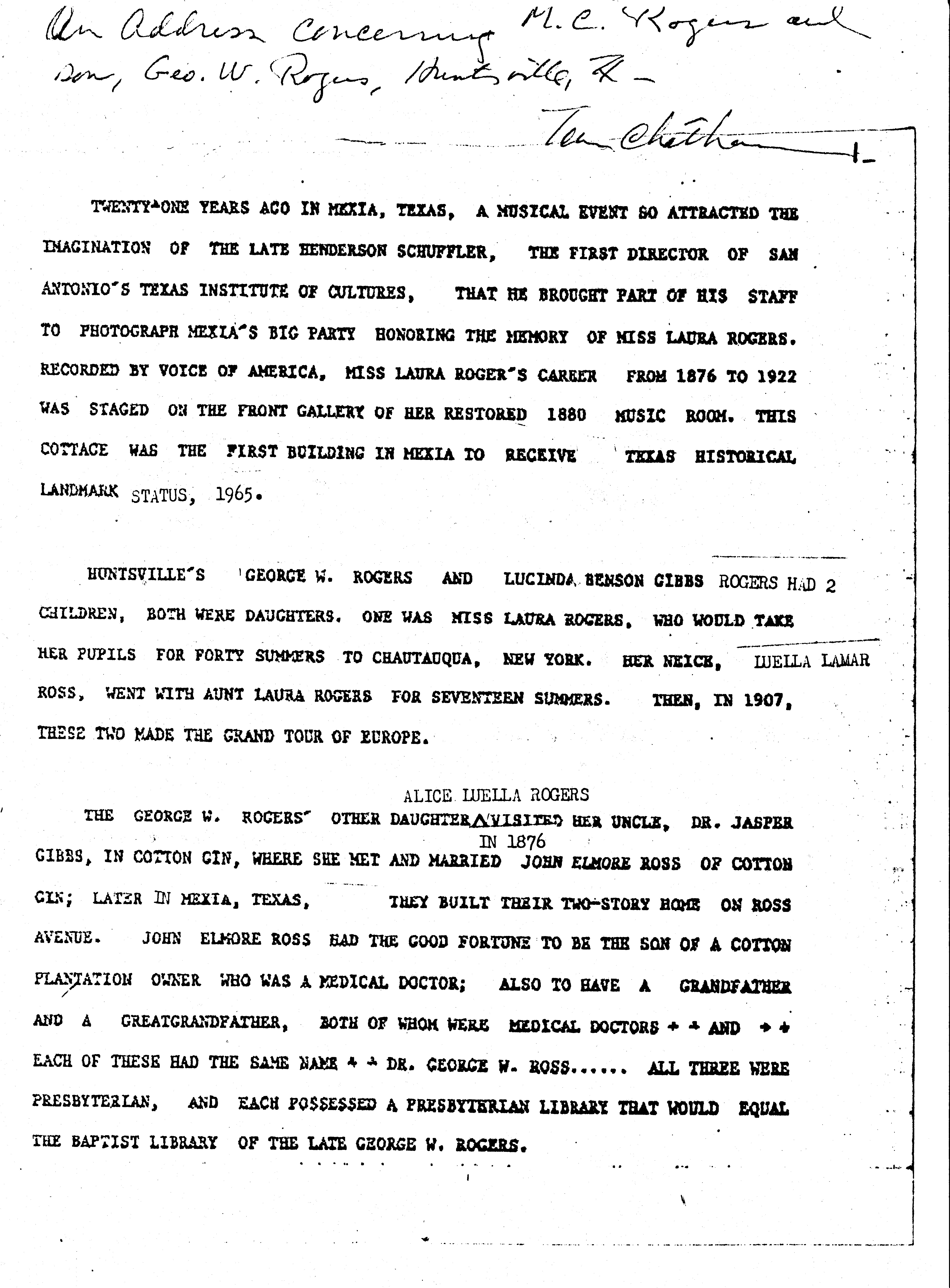
This text (below) was given as an address during an event to honor of Laura Terrissa Rogers at her "Music Room" in Mexia Texas. The date attached in Ancestry is 1886...which  was early in Miss Rogers' career. If it was 1986 that's after the  death in 1956 of Thomas Chatham who wrote the note at the  top) So at this point I only know in 1965 there was a celebration. When the one was that is in the first paragraph of the following text, I'm not sure.

It also includes some interesting information about my great grandfather, George W. Rogers, and his father M.C. Rogers. The only thing I've found that is inaccurate is the statement that George W. Rogers was "only parent to Luella and Laura Rogers." He also was the father of William Sandford Rogers, (1850-1879) my Great Grandfather!

Thomas Chatham, who signed the note at the top of page one, was son of Mrs. Lamar Ross Chatham, daughter of John Elmore Ross and Luella Rogers Ross. So Laura was his mother's auntie.

AND an update regarding that first paragraph of the San Antonio's Texas Institute of Cultures...I found it is still in existence but struggling to continue due to funding shortages. I emailed them with that first paragraph, and they called me back on Wed. Jan 10, 2024 and said they had no records of the event I was referring to. I asked if they had records from 1965...thinking that wasn't all that long ago, but she continued to just say they had no records. She referred me to the San Antonio library's genealogy reference section. I said I should also try the Mexia Library and Historical Societies, if they exist. So that was a dead end for now!


Sharing with Sepia Saturday this week.


Friday, January 5, 2024

Sod house construction


 Photo: A homesteader and his family in front of their sod house in Cherry County, Nebraska. C.1900 (Photograph by Solomon D. Butcher)

In a 1959 correspondence from Ollie M. Hoback to his half-sister, Mrs. Clay Jenkins, an account unfolds detailing the construction of a sod house by his father on the vast Nebraska prairie. The letter provides insights into this bygone era, capturing the essence of the laborious task undertaken by Ollie's father.
“In the fall of 1883, my father, Isaac Newton Hoback, built a sod house astride the section line, whereby one half of the house was on his homestead, and the other half on presumption land. The law said the homesteader had to make the homestead his home (and only home) for at least six months of the year.
On a presumption, one had to live on it six months and pay $1.25 an acre. By this method, one could live in one end of the house for six months, and then move to the other end for six months, satisfying the law.
Our land was about three miles from McCook, Nebraska. I watched Father plow the sod for his house. The Buffalo Grass roots held the sod together for great lengths—a mile if you wanted to plow that far. The sod would turn over just like a board.
After the first furrow was turned, the second one would lay down and fit into the furrow space left by the first one. The field would just lie there like a smooth black expanse. Any fair team of horses could pull a twelve inch plow, so the sod strips were four inches thick, twelve inches wide and cut the length you wanted to use for the width of your house walls. Father used a sharp spade and a measuring stick for uniform size.
He took the regular bed off the wagon and laid flat planks on to make a flat bed. He picked up the cut sods and hauled them to the house, building the house walls as he unloaded the wagon. He drove the wagon along side the sod strips, loaded, and pulled the wagon so near that the sod could be placed right in the proper wall location.
When the walls were about five feet high, he started standing on the wagon bed to place the sods. There was no mortar or daubing for the sod house, nor was there a foundation.
The first block of sod was laid grass side down on the grassy ground. Subsequent blocks were also laid grass side down and the grass acted as a sealant and a mortar to seal sod to sod.

Also thanks to History Shortcut Facebook page

Saturday, December 16, 2023

Cousins of my father's

Week 51 (Dec. 17-23): Cousins

My challenge is to skip my first choice, which was to have spent time with my first cousins this fall, but I've already blogged about our visit HERE.

So let's look back at cousins that might have been part of the lives of ancestors.

My mother had several cousins growing up. My father met some cousins at one time with his brothers. He may have stayed in touch with them later in life. All I have to go on are a few photos.

I just discovered my external hard drive won't turn on. I'm hoping it's just the connection. Otherwise, that will be a big loss of many old photos. Anyway, blogs have a few of my photos that I can scroll through!

Here are my father's cousins as adults.

My mother, Mataley Munhall Rogers on left, then my dad's cousin, Zulie Winslow Seamans, next to  her mother, Stella Swasey Winslow (Aunt Jim) and then her sister, my grandmother, Ada Swasey Rogers.

Men behind are Uncle Chauncey, his brother my father George Jr. Rogers, maybe his cousin who was close to my father's age, Billy Winslow, then my grandfather in hat, (Poppy) George Rogers Sr.

So Gummy (Ada Swasey Rogers) and Aunt Jim (Stella Swasey Winslow) were sisters. Gummy and Poppy were parents of Chauncey and George Rogers (as well as Alex and James not in photo.) Stella's husband died in 1923. Her children were Zulie Winslow Seamans and Billy (William Swasey Winslow).

I just love the clothes these family members were wearing. I wonder what that fur collar my mother is wearing might be. I am pretty sure my parents and the senior Rogers lived in San Antonio TX at the time (around the time my parents met sometime in 1935 until they got married in 1939.)


Chauncey Rogers, Zulie Winslow, Alex Rogers, and George Rogers, cousins in Kansas City, Mo in 1918. My father, George was 4 as they visited their mother's sister's family.  Zulie was a cousin while Chauncey and Alex were his older brothers. Since the boys all came from Texas, this snow must have a wonderful treat for them! I imagine the took the trip in 1918 on a train from Texas.  

I'm glad I had to check my ancestry files to find out if there was a special event at the time of the Rogers visit from Texas to Missouri. I had a vague date of the birth of cousin Billy (William Winslow) of 1918. But a hint gave me the correct June 2, 1917 date of birth for him. So I guess that had nothing to do with the visit in the winter.

Other details are in the notations of Alex's weight of 40 and date of Feby 10 1918 , and Chauncey's weight of 70 and a date of Feby 12, 1918. All the writing is that of my grandmother, Ada Swasey (Gummy) Rogers.

I wonder if the weights of the boys had something to do with their fares on a train...

Gladly sharing this with 52 Ancestors 52 weeks...as I have for the whole of 2023. Can I finish it?


Sunday, December 3, 2023

Grandmother's recipes - maybe

 52 Ancestors, 52 Weeks: Week 49 (Dec. 3-9): "Family Recipe"

I can only say these recipes came from my mother. Not any grandmothers here, except I'm now one. I know my father's mother's recipe for fudge, but it's in my head, never written down. And that is the way it's going to stay. The secret Rogers Fudge recipe.

I've got a wonderful old book where 3x5 cards may be slipped into sleeves, and then placed in an appropriate index section. I must have been given it maybe 40 years back but kept my recipes in the little file box of 3x5 cards for some time, before finally filing them in the book. That's probably why the book is still in good shape...but the cards, well, just look at them!


Some cards are from my mother's cards, copied. Some of her's were from her Betty Crocker cookbook. Some were on her own file cards! And I also opened a library copy of a cookbook and copied some of those recipes, and never have cooked them!


As you can see, I slipped some clipped recipes into the sleeves also. This is in my Mother's handwriting.


Have you noticed a theme here yet?


Baking was my interest, in order to feed those wonderful children I expected to have. (Certainly not for my own tastes!)

These were typed by me, though I didn't have a typewriter of my own. Maybe when I'd been working somewhere I decided to get these recorded. I've obviously cooked them many times. Though I think Florida little critters may have contributed to some of the markings...which we won't think about, since there was already flour, butter and sugary fingerprints on them!


This is one of my favorite cookies. So soon I shall get a baking again.


Sunday, November 26, 2023

Troublemaker

 I've brought some kind of post for all the 52 Ancestors 52 Weeks so far. But this one is hard!

Week 48 (Nov. 26-Dec. 2): Troublemaker

OK, a fourth great uncle was Legrand Booth. (On my mother's maternal tree.) There were some troubles, though I don't how many were his doing.

I looked at Legrand Booth, because he had some tough times in his life, with several documents of insolvency. He started out life as a shoemaker, much like his father. I don't know how that would have resulted in a huge debt, but perhaps he tried buying more property than he could afford.  

I found an interesting letter that described some of that family. 

Letter sent from Ruth Kelsey Proctor to her Aunt Elizabeth Halverson, Uncle Roy Booth, Brother Harold Kelsey, Daughter Ann Proctor, Nephews Douglas, Robert, David, and Jeffrey as well as many of her first cousins as possible at the time (too numerous to list individually). Ruth took it upon herself to document much of the Booth-Carter family tree and history in the late 70s and this was the cover letter and brief overview of both families that she had found.

-----------

The Booth family tree starts with Legrand and Betsey, both of whom were born in the late 1700’s. They had 12 children, the ninth being Elliott Lansing Booth, ray [my?] great grandfather. I have no information about the Legrand Booth family ex­cept what is contained in a letter dated April 23, 1859, addressed to Elliott Booth by his brother-in-law, Chester Gooding, E. Bloomfield (state not given). I will quote parts of the letter as it mentions places where some of the family lived:

“I will give you an account of your father's family. Your mother died January 8, 1852.  The family at the time of her death consisted of your father, Lafayette (Erastus), and Annjeanette, Lucius having been married the fall before to Mary Hopkins. After a time your father becom­ing dissatisfied and uneasy they concluded to break up and leave and your father went to live with Emeline who lived in Lafayette, Indiana, with her second husband, Mr. William Cochrane, having been divorced from Hummer who had left her and run off with a female spirit medium. Mr. Cochrane, being a very wealthy man and a large land holder and not enjoying very good health, Emeline wrote to Lafayette and father to come and live with them. Your father went up in November 1852. He did not like living in Indiana and left there in the following summer and went to Fitchburg, Dane County, Wisconsin, to live with Eli who was married and living there. Your father writes that he likes Wisconsin very much and enjoys excellent good health.

“Lafayette married in Indiana and also left and went to Fitchburg to live. He stayed there until this spring and has now returned to Lafayette and is in the County Clerk's office writing at a salary of ten dollars a week.

Edward is in Joliette, Illinois, and is not married. Lucius moved last fall to Mundy, Genesee County, Michigan. Elizur lives where your fa­ther used to live and has as much flesh to carry about as your father ever had. Ann Jeanette is living with us.”

Elliot Booth (1832-1885) was son of Legrand (1772-1861) and his wife, Mary Elizabeth (Betsey) Peck (1790-1852). 

Elliot's brother was Erastus Lafayette Booth (1827-1907) who became an MD. Ann Jeannette (1830-1902) was the baby of the family. Elliot's brother, Everett Lucius Booth (1828-1861) had indeed married in 1851.  

Elliot's sister,  Emeline (1820-1895) had some interesting things happen with her 3 husbands. First when she was 23 yo she married Rev. Michael Hummer, in Indiana. Ten years later in Iowa they have a daughter Emily and we know nothing more about her. As cousin Ruth Kelsey Proctor said in her transcription of the original letter (do you think it was in the original?) that she divorced Rev. Hummer  "...who had left her and run off with a female spirit medium." So in 1852 she married the rich William Kerr Cochran (1807–1864). (She ended up being buried next to him). But wait, there's the connection of brothers and sisters between those two husbands. Her second husband had been married before, to the sister of her first husband (the one who ran off with a female spirit medium.)

"William Kerr Cochran's 1st wife was Nancy A Hummer (1807-1851). Nancy A Hummer and Michael Hummer were brother and sister.

Her third husband was Alexander Carlton King, whom she married in 1875, at age 65. She had been a widow for 11 years by then. We don't know when King died. Emeline lived to 84.

Chester Gooding goes on with details of other of the siblings. 

But we need to look closer at the dates of Legrand's wife's death...in 1852. Chester speaks of different adult children taking him in.

But is it possible he married another woman on Jan 16, 1844. Clarissa Hotchkiss, in Naugatuck CT, stating that Legrand was from Hartford, CT? It was a church wedding. 

BUTthere was another Legrand Booth, son of James Booth (not our Legrand, son of Isaac.) He (the other one) was born in New Milford CT, between 1712 and 1860. It's possible that that Legrand married Clarissa Hotchkiss. There's absolutely no data on Clarissa. There were a lot of Booths in Connecticut.

By the time Legrand and Betsey Booth had their fifth child they lived in Canandaigua New York, as well as Legrand's father Isaac and his family. It is one of the finger lakes. But as mentioned in the letter above, many members of the family moved further west through the years.

Canandaigua New York finger lakes


Sunday, November 19, 2023

The Bass family and Nansemond Indians

In Suffolk Virginia, the Nansemond Tribe is alive and well.


Kurt Williams of station WKTR spoke about the Nansemond Indians on Nov. 16, 2023 at 6:11 am on his report. It was posted on Facebook for a while. Here are just a few clips from it.

SUFFOLK, Va. — What do you really know about the indigenous people who call Virginia home? We're in the middle of Native American Heritage Month and News 3 is taking a closer look at a tribe right in our backyard—their latest challenges, old and new.

The Nansemond Indian Nation powwow is a chance to get a taste of their rich culture. The annual event is held along the banks of the Nansemond River in Suffolk, where their tribal headquarters is. The area, called Mattanock Town, is north of downtown Suffolk in the Chuckatuck section...

...Keith Anderson, the Chief of the Nansemond Indian Nation ... explained the significance of the [Nansemond] River.

"So, there's a lot of history to where we're walking right now. This area... was inhabited by our people thousands of years ago. Our tribes here, they would live [by] hunting, fishing along the Nansemond River."

My great grandmother was Elizabeth "Bettie" Bass Rogers, and our line can be traced back to the Nansemond Indian woman, Elizabeth (Keziah) Tucker, who married John Basse in 1638.

"Each of us has some relationship to the river, but for us it's not just a relationship, it's our identity," said Tribal Vice-chair Nikki Bass during a recent boat ride on the Nansemond River.

Photo by Michael Woodward

The Nansemond Tribe has high esteem for the earth as well as the river, and partners with the Chesapeake Bay Foundation, in their ongoing oyster restoration projects