description

My own life and my opinions are shared at When I was 69.

REMEMBER: In North America, the month of September 1752 was exceptionally short, skipping 11 days, when the Gregorian Calendar was adapted from the old Julian one, which didn't have leap year days.
Showing posts with label Col. Richard Bass. Show all posts

Friday, September 6, 2024

Ancestors of interest...chapter one

First, let's look at how she's related to me. I just like knowing the ancestors strings, tangled though they may be.

Sarah Louise (Lou) George Tompkins' mother, Mosley (Molly Ann) Bass George, 

b. 17 June 1812 in Perry AL, d. 17 Oct. 1850 Marion, Union Parish, LA 

was sister to my great great grandfather...


Col. Richard (Dick) Bass 

b.3 Jan 1819, Perry County AL, d. 5 May 1880, Waverly, Walker County TX.


so she was my first cousin three times removed.

This first part of her memoirs covers from her birth in 1842 to the yellow fever epidemic in 1850.

(I will use italics for my comments as Notes)


  THE MEMOIRS OF LOUISA GEORGE TOMPKINS

Union Parish, Louisiana

Submitted by Chuck Kinnison.

Sarah Louise (Lou) George Tompkins Specht
(WRITTEN IN 1926 AT THE AGE OF 84 YEARS) BY WAY OF INTRODUCTION To gratify the insistent desire of children, grandchildren, and friends, I shall begin a book of reminiscences. Some have suggested that an unvarnished life story, if frankly and simply told, might be of interest and help to others. In the careful introspection of my life I realize I have achieved so little; that there is not much to tell. Material for a book, the foundation of which depends on the gleamings from a "child's" life which began more than three-fourths of a century ago, will be mixed with much that is of little interest to anyone but the writer. While unraveling the threads that were used in the woven garment, many knots had to be tied, leaving the blemishes of neglected opportunities. Still, with the many imperfections, I am glad to say there are also happy reflections of the opportunities embraced. The seeming egotism in the book will be pardoned when it is observed that I am trying to give honor to the Great Friend who inspires the hearts of the willing and obedient. PART 1: THE FIRST HOME I was born on a farm near Hamburg, Perry County, Alabama in 1842. Elias George and mother, Ann Bass George, were the parents of nine children,--four sons and five daughters, of whom I was third from the youngest. All lived to maturity, married and raised families, except one brother, "Jeffy" , two years my senior, who at the age of eight years was thrown from a runaway horse. My parents were missionary Baptists, and we were early taught to reverence the name of Jesus, respect the Sabbath day, be kind and charitable to the poor, to servants, and to animals. There was family worship every night before retiring, and my mother would have the servants come in and to join us at such times. We were a happy family because children and servants were taught obedience to those who ruled them. We loved our servants and they loved us. My father, being a slaveholder, had a large plantation on which many supplies for home consumption were raised, such as corn, cotton, potatoes, barley, and peas. The home was a large, rambling two-storied building, and each of the various rooms had a fireplace. But the room that charmed me most was the nursery,--a large room with windows facing southward, overlooking the pasture, and in the springtime there was much interest in the horses and the little lambs as they chased each other and gamboled in the field. Our black mammy Chloe, was installed as guardian and caretaker of the nursery. Its inmates included three children, from one to five years old and two nurse girls, Mariah and Harriet, who were ten and eleven years old. The girls, under the supervision of mammy Chloe, would see to our bathing, dressing, and feeding. When the weather permitted, we were kept out doors in the sunshine and although the girls ran and played with us, our black mammy was ever near and watchful that no harm befell us. It is difficult to make it understood what love we had for Mammy and the girls. This attachment lasted even to old age. Mammy died just a few years (original sheet cut off). I would not have one think that our precious mother neglected her little children under these conditions and surroundings. She had duties devolving upon her, which could not be done by others. There were nine children to clothe and feed. While she had servants who cooked, washed, ironed and sewed, she supervised each department. There were no sewing machines nor ready-made clothing. We were strangers to most of the conveniences in common use today. Even soap and candles were made at the plantation. My father raised everything possible at home and a yearly trip to New Orleans resulted in the equivalent of a carload of provisions, dress goods from England or New England and many other things needed for the plantation. Oranges, apples, dried fruits, and candy were bought by the barrel. How well do I remember the picturesque surroundings of our home. There was a long sloping hill to the rear of the house, at the foot of which was a cold, gushing spring, and directed channels went forth to the house lot, chicken yard, and other needed places. A milk house was built over this spring, the floor of which was laid of large, flat rocks, so arranged that the stream was conducted over a channel two or three inches lower than the floor and wide enough to hold several pans of milk and butter. Our home was surrounded with mocking birds, swamp sparrows, field larks, whip-poor-wills, blue jays, and cardinals. They were never disturbed and consequently, many became quite tame, often feeding with the chickens, geese, ducks, turkeys, and peafowls. The whip-poor-wills could be heard at night in the swamp below, sometimes coming into the garden as though they wanted to serenade us from the branch of an oak tree near the house. I recall an evening twilight when one ventured on the lawn near the house-steps and called lustily " Whip-poor-will! Whip-poor-will!" and after satisfying himself, he flew to his companions in the swamp and soon the air was filled with their " Whip-poor-will"! and "whip-will, the widow!" Their concert lasted through the night, interrupted occasionally by the deep, sonorous voice of an owl loudly calling, " WHO! WHO! WHO! WHO! WHO! ARE YOU!". The loud laugh of another owl answered, " WAH! WAH! WAH!". I would often lie awake
(original page cut off) of sounds was inharmonious and weird; nevertheless, their
singing kept me from being lonely on wakeful nights.
 
 I can't leave this subject without taking you to the squabbery, which had to
be entered by climbing a stairway into a large room built in the poultry yard. 
It had hundreds of nests built in the wall.  I often went with Mary, the maid
to get squabs for breakfast and many were given to the neighbors.
 
 Other impressions of this home were the negro quarters which were a half-mile
from the house.  And there was a summer-house covered with coral and French
honeysuckle vines where the mocking birds often built their nests.  Also,
there were the flowers which grew profusely along the branch and filled the
air with their fragrance.
 
 These are the memories of my first home.
 
 THE MEMOIRS OF LOUISA GEORGE TOMPKINS 
 PART 2:  MIGRATION TO LOUISIANA
 
 
NOTE:  The first page of this chapter is missing.  She is evidently describing
the wonders of the new country in Louisiana which induced her father to sell
his home and migrate to Louisiana in 1848.
 
 _____________________contributant (bayous, creeks, and branches) flowing in
every direction, with cane breaks and swamps and filled with deer, bear
panthers, wolves; all of which helped to enhance the reports previously given
him by friends,---to say nothing of the natural growth of several kinds of
fruits and nuts.
 
 It is needless to say that the dear old home where my mother and father had
lived since their marriage and which had been the birthplace of their nine
children, was doomed.  Also, a beautiful new home near Marion, Alabama was
being completed.  This was a large, two-story house, quite modern in all its
appointments (for that time).  The inside work was superior to anything of its
kind today; the plastering was very hard and glazed.  The parlor and hall were
heavily frescoed around the edges of the ceiling, with a large wreath of
flowers in the center of each for the chandeliers.  My older sisters and
brothers were at the age when they needed to be in college, as they had
outgrown the country school.  To educate them had been the incentive for
building in Marion, as it was a residential city of schools and churches.
NOTE:The "beautiful new home near Marion, Alabama" was in Perry County AL, where they had been living. So it was a city home as compared to the plantation.
But to my father, nothing was too great a sacrifice for this "Land of Paradise" ,---not even the many friends and relatives with their earnest protests, or his popularity as a minister of the gospel. Nothing could outweigh his desire to possess a home in this unexplored wilderness---a venture of toil, self-denial, hardships, and untried experiences. Without taking it to the Lord in prayer, and seeking divine guidance of Him whom he served, he straightway sold his valuable plantation and lovely new home at a sacrifice, and was soon in readiness for the journey by caravan. (bottom of page of original cut off)
  parting with life-long friends, one of whom was her favorite sister for whom
I was named.  She had three sisters who were living in Louisiana, and also her
mother, near whom she expected to live.  But this pleasure could not
compensate for the pain of parting with that precious sister who lived but
three months more and whose death was mother's first great sorrow.
 
 Early in the spring of 1848, the day for departure arrived.  Three or four
families decided to cast their lot with us in going west, which at that time
was as far distant as is California now.  The trip had to be made in private
conveyances, drawn by horses and mules, and it would take weeks to reach our
destination.  Besides this, my father was taking with him 400 Durham cattle
which were to be driven by herdsmen.
 
 The caravan included about 50 covered wagons, carriages, carry-alls, and
buggies.  These and the horseback riders assembled at our home, and many
friends came to bid us "un bon voyage" .  How well do I remember that first
day, which to me seemed a gala affair with many more to follow.  I was too
young (six years) to realize what it meant to those on whom the burden fell,
nor what awaited us in the future.  The morning was bright and beautiful, and
although the sun gladdened the earth, it was unable to penetrate the gloom
which hung like a pall of dark foreboding in the hearts of some who
reluctantly bade a last farewell to loved ones.
 
 My mother rode in a carriage with four of her young children; a brother older
and a sister and brother younger than I.  The driver' s seat was high in
front, and in the style of the period, the nurse's seat was in the rear.  This
was supplied with a step or foot rest and arms, as with an armchair.  The
first day being cold and crisp, mother had the driver stop at a store as we
passed through Greensborough, and bought us children beautiful wool hoods and
each a tin cup, painted red and blue, with " Boy"  or " Girl"  stamped on it. 
These were suspended from our necks with ribbons.
 
 The caravan necessarily traveled slowly and when we children were tired of
riding, mother would let us get out and walk, always attended by the nurse. 
(Original page bottom cut off).
 
 Long before night, the captain, (father) always went ahead to find and
arrange for a suitable camp ground where wood and water could be obtained, for
provisions also to be made for the cattle as well as the teams of mules and
horses.  Having found such a place, he would wait for the crowd.
 
 The camp ground reached, the overseer of the negroes superintended the
location of wagons, tents, and animals.  The negroes' tents were grouped by
themselves and the white families were in a different location.  Each family
of negroes had its separate tent; each woman cooking for her own family, while
the men got the wood, attended to the feeding and caring for the stock and
pitched the tents.  There were log fires in front of family tents, and after
all were fed and the little children were in bed, the white families would
visit each other,---sit around and exchange experiences and jokes till nine or
ten o' clock.  The negroes would have their social time until the gong sounded
for retiring; after which quiet soon reigned, except for the occasional lowing
or neighing of an animal.  At five o' clock, the gong again sounded and all
were up and hustling with preparations to travel.  Then at noon, a stop for a
couple of hours was made, with rest and lunch for man and beast.
 
 We had to cross the Tombigbee River in Alabama which we found to be a
half-mile wide from recent rains.  It took two or three days to make the
crossing, for the cattle had to be ferried across.  Upon taking one load, the
cattle became frightened and stampeded, and several leaped from the flat-boat
and were carried by the swift current down stream, and two or three of these
were never recovered.
 
 Having surmounted this obstacle, we proceeded on our journey with nothing of
importance to note except that one night we camped in a lovely grove of oak
trees enclosed with a rail or worm fence.  A railroad track ran along the
outside of this enclosure, and we were warned not to cross the fence; that a
train would pass by very soon.  We hadn't waited long when a shrill whistle
heralded its approach.  We all stopped and gazed at the wonderful monster, as
it seemed to me, for in those days, railroads were rare to country people.
 
 At last we reached the Mississippi, which we crossed at Vicksburg on a
ferry (bottom of original page cut off) 
have been indelibly stamped on my
young mind.  We finally reached our destination which was a beautiful grove of
oak trees, in the midst of which was an eight-roomed cottage.  Also, there was
a summer-house covered with coral honeysuckle and woodbine and in the yard
there was an abundance of flowers.  My father had purchased this farm with 600
acres of improved land and under cultivation, to serve as a temporary home
until there were further developments.
 
 This home was three miles from Marion, a village in north Louisiana, in Union
Parish.  It was settled and named for Marion, Alabama by its earliest settlers
who had come from that place. 
 
 THE MEMOIRS OF LOUISA GEORGE TOMPKINS
PART 3:  THE FIRST YEARS IN LOUISIANA

 Father had bought 4,000 acres of timbered land within four miles of Marion,
which was to be cleared and converted into a plantation,---with cottages for
the negroes, a dwelling for the overseer, and with gardens and outhouses. 
This kept all hands busy for the first year, with only time enough to
cultivate the 600 acres of the home place.
 Soon after being installed in our new home, my second brother (Frank, 17) and
brother Jefferson, 8 years old, started to school in Marion, riding horseback. 
Coming home one evening, the horse ran away with them; the saddle girth broke,
and my younger brother was dashed against a tree.  He lived only a few hours. 
Brother Frank (cousin Onie's father) after lingering between life and death
for several days finally survived.  This was mother's second deep sorrow. 
Indeed, to all the family, it was the darkest day we had ever known.
 
 In the Fall of that year, a baby girl was born to my oldest brother's wife. 
On being told that I was its aunt, I rose several degrees in self-importance
in the fact that I, six years old, was an aunt.  Seeing sister Mat (baby
Josephine's mother) tatting, I gave her no rest till she had taught me how to
do it and I persevered till I had made about a yard which satisfied me for
that time, but I never forgot how, and often used this knowledge along the way
of life.  It was soon after this that mother taught me to knit.  There was a
negro girl of my age (daughter of the milkmaid) whom mother was training for a
house-servant.  She was also taught to knit.  Mother would measure off five
yards of thread; tie a knot; and when we had finished this task we could play
for a half-hour; then she would call us and repeat the task.  We would race to
be the first to finish and in this way we became rapid knitters.  At the age
of seven, we could each knit stockings from the beginning to the end without
help.  Mother would have us knit the winter socks for the negro boys who
worked on the farm.  The thread was spun at home from wool sheared from the
flock of sheep,---a flock of four or five hundred.  My father had bought them
with the farm also, many hogs.  There were numerous milk cows, some of which
gave a large bucket of milk twice a day.
 
 The next Fall, found that much had been accomplished in clearing and
building, and by the time winter had set in, all the negroes were comfortably
housed with large fireplaces in their cabins and good beds and plenty of wood. 
For our family, a temporary dwelling had been built about a mile from the
plantation on a high hill with a good spring of water, and to the rear of the
house was a branch running in a ravine.  In the spring many wild-flowers
filled the air with their fragrance.
 
 After moving into this newly built forest home, five miles from town, my two
oldest sisters, Lizzie, 15 and Sue, 13 attended school in Marion, boarding at
the home of mother's brother, Uncle Dick Bass.  The carriage was sent for them
Friday afternoons, and took them back early Monday mornings.
 
 The Spring following, father began to build a residence in Marion, having
purchased 25 acres of land with a bold spring and a branch of fresh water
flowing from it, which soon ran through the horse-lot and orchard, all of
which was prearranged when planning the home surroundings.  Our parents were
bending every effort to hasten the time when we could move to town and get
those old enough into school.
 
 But alas! alas!  " Man proposes but God disposes."   Although our forest home
stood on a beautiful hill, with a spring of pure water,---and to all
appearances, a most healthful location, we little dreamed that an enemy was
lurking in the air, having risen from the low damp marshes and stagnant pools
of water which had not been drained; and that the dying vegetation was filling
the atmosphere with poisonous germs and these were inoculating almost every
member of the family (white and colored) with yellow fever germs.
 
 We were all infected about the same time the physicians advised the family's
removal to an old and settled place.  My grandmother's home was about four
miles distant,---and being unoccupied, we moved into it---carrying four sick
children on beds in a carry-all.  The children were a sister (Jane), my
brother Elias, a colored girl my age, and myself.  Two of the house servants
(Julia, the cook), and Mary, the house maid, were removed to the plantation. 
The gardener and the milkmaid escaped.  These along with two other women from
the farm went with the family as house servants and to help nurse the sick. 
Everyday, mother rode horse-back to visit Julia and Mary to see that they were
properly cared for.  Physicians attended them daily and every effort was made
to save them,---but all in vain.  Mother was heart-broken over this sad
calamity for they were almost like her own children, and they were devoted to
her.  The little negro girl my age who was taken to Grandma Bass's place, died
a few days later.  There were no trained nurses in those days, but the
neighbors did everything they could in caring for the sick.  In a pioneer
country, citizens were dependent upon each other in times of adversity.
---------------------------
A sad time, and more sickness occurs before recuperation begins for Louisa George, our narrator. This was in 1850.
Tomorrow I'll share a second chapter, but there will be several more about this interesting ancestor's life.

Sharing with Sepia Saturday. 

Tuesday, January 26, 2021

Col. Richard Bass

 A repost from 2014: This week I'm concentrating on the Rogers Family Tree


Richard Bass was born in Perry County, AL  on 3 JAN 1819.  He was the father of my grandfather (George Rogers') mother, Bettie Bass Rogers.  He served in the Confederate army in Mississippi (from Texas).  (Source: Historical Data Systems, comp.. American Civil War Soldiers [database on-line]. Provo, UT, USA: Ancestry.com Operations Inc, 1999. Source 425.)


His father's estate had a petition against it which gives Richard's birth as 1814.  This date is not corroborated by his census data as well as his grave marker which all reflect an 1819 birth.  So the legal petition in Alabama was probably wrong, but it may have helped in some legal sense for him to be of a different age..  Another source has him born in NC rather than AL.  Wherever he was born, he was the youngest of 8 children of his parents, and his father died when he was very young, and he was raised by a step-father. His mother was Julia Ann Holloman Bass Green.  Father was John Bass, both from Wayne County, NC.  His step-father was Jetson Green, who raised him from when he was around 6 years old. (NOTE: I haven't found anything to substantiate this, besides court documents by Green asking for guardianship...not receiving it, but he did marry Mrs. Bass.)

Richard Bass married Mary Ann Elizabeth Powell on 12 Oct, 1839 in Perry AL, at age 20.  They moved to Louisiana, Union Parish, by the time he was 30, according to the 1850 US Census records.  The birth places of his children put that move between 1841 and 43.

Then the family moved again, according to 1860 Census records, to Walker County, Texas.  His age is listed incorrectly as 20, though he is definitely 40.  At the cusp of the Civil War he was middle aged.


Downtown  Huntsville, Walker County, Texas 1870s

Next census for 1870 shows him in Walker County, working as a merchant, rather than a farmer as he had previously identified himself in census reports.  Being a merchant meant he probably lived closer to a town at this time, perhaps Waverly, where he died.

Most of the Bass children were born in Waverly, Texas or Walker County, Texas.

Col. Richard Bass died 5 May 1880 in Waverly, Walker County, TX, where he is buried.  The Handbook of Texas History says 
In 1986 all that remained of Waverly was a cemetery, a nearby Presbyterian church, and a rural subdivision called Old Waverly, which had a population of about fifty people. Texas historical markers were erected for Old Waverly in 1969 and for the Waverly Cemetery in 1978.
More information about the settlers moving to Waverly includes this:
In the autumn of 1852 some 300 people from Alabama, including slaves, moved into the Waverly area. The town was surveyed, mapped, and incorporated in 1858. According to popular legend the town was named for the Waverly novels of Sir Walter Scott. Some considered Waverly to belong to the South of "moonlight, magnolias, and landed gentry." In reality it was a small enclave of the slave-plantation system imported from central Alabama. Waverly Institute, consisting of a male and female academy, was established in 1856. A post office operated from 1855 until 1872. A Masonic lodge operated from 1861 to 1865, and Methodist, Presbyterian, and Episcopalian congregations were started in town.
What became of the tiny town?
In 1870 San Jacinto County was formed from a part of Walker County, including the Waverly area. At that time Waverly leaders, in fear that the Houston and Great Northern Railroad would bring "tramps and ignorance to the town and kill cattle," refused to give the railroad right-of-way. In doing so they ensured the rapid demise of Waverly. The town of New Waverly was established ten miles west of Waverly in 1870 to take advantage of the railroad and became a prosperous town .
A bit more information can be found here...about Waverly, Texas. 

I've posted about his wife, "Mae" Mary Ann Powell Bass HERE.

Ada & George Rogers Sr. and granddaughters Mary Elizabeth and Barbara Booth Rogers 1948 Houston TX. I'm adding this photo to posts in the George Rogers Family Tree.

Saturday, September 14, 2019

John Bass' siblings of Wayne County NC

John had about 6 siblings who lived until adulthood.

One thing I find may change my records is his owning land and being on a census, which tells me a birth was possibly earlier than I thought, because several of these titles for land would belong to 3-8 year olds otherwise, (was that legal?)

I'm currently trying to find out why Ancestry has two of his brothers named William!  One was supposedly born in 1792, and one in 1796. The 1792 William apparently lived until 1884.  The other William Bass (both sons of Edward and Sarah Bass on the same Ancestry trees) lived until 1858.  There are lots of records (some on both of their trees) and yet only one apparently married, and neither had any children, according to the will of the one who was married.  He fought in the War of 1812, and his wife got his pension from that war. I also have grave markers for that William and his wife, Nancy Maria Brogden Bass, in Goldsboro, Wayne County, North Carolina.

I wonder what the relationship was between these two men, or if they were the same person who somehow got statistics jumbled.  There's no way to tell any difference on census or war records, except where a birth date is also clearly given.  And once the Ancestry trees publish that a man is the child of certain parents, it's harder than heck to figure out if maybe he was a cousin.

I'm fortunate that some of my current cousins who are working on the same ancestors, sometimes make comments that help me figure out some relationships.

For now I'm going to combine these 2 Williams...and let the details sort out somewhere down the line.  With all that paper work of probates and wills, it's probable that the real William may have written more than one will (thus the use of many photo copies of his signature, and statements attesting to its validity.)

Oh dear, I just found out there are also apparently two Richard Bass' listed in Ancestry, as brothers of John Bas. I thought the one most likely had been the one who also died in Perry County AL. However, there's a document (details below) stating he lived in Tennessee and died around 1802, and had at least 3 heirs.  The other Richard doesn't have any heirs, nor a wife indicated. So (for now) scratch him, and bring back all the Tennessee Richard's information.

John's brother Richard Bass moved to Tennessee apparently (as mentioned in the probate documents of the father Edward Bass in 1802-1807.)  I'll include the description of that document here, because it names relationships of all of John's family at that time, even though it pertains to his grandfather.
Edward died in 1802 intestate leaving heirs at law: wife Sarah who has died during probate yrs.; son John Bass who died leaving issue Uriah, Mary, Betsy, Sally, Ann, Keziah, and Richard all living in AL early during probate; son Andrew Bass living in Johnston and Wayne NC; son William Bass of Wayne NC; son Uriah Bass who died as minor during probate without issue; son Richard Bass of Tennessee who died during probate leaving issue Elizabeth Bass Boyte (Thomas), Sally Bass Jacobs (Wm.), and Edward Bass all of TN; daughter Mary Bass a minor in 1802 who has married Britton Hood; and, daughter Keziah Bass a minor in 1802 who has married John Cox. The latter 2 girls are petitioning against the estate as they were young and not aware of their rights in 1802 so the property is being re-evaluated and divided in 1826.
Using John's father Edward's document, we know his siblings were:

Andrew (Johnston and Wayne Counties NC)
Wiliam (Wayne NC)
Uriah "who died as a minor during probate without issue" (between 1802-1826)
Richard of Tennessee "who died during probate" between 1802-1826
Mary "Polly" Bass Hood 1785-1850 (noted as being a minor in 1802)
Keziah Bass Cox 1785-bef. 1850 (also noted as being a minor in 1802)

And while looking at a site for Andrew Bass, up popped a "Find a Grave" site for (believe it or not!) yet another Richard Bass who died in another NC county, and is buried there in the Bass Cemetery in 1866, here's the link...but I don't know how he's related, and he's certainly not the one in Tennessee.

I am using these birth and death dates, but must remind you (and myself) that they aren't written in stone (unless they were on a headstone.)

Andrew Bass (1797- probaby died around 1836 in Perry County AL)

"5 Jul 1839  Joseph Vanderslise, Rynard/Renard Vanderslise, and Uriah Bass sign for Andrew Bass estate. Joseph Vanderslise appointed guardian for Sarah, Keziah, and Jerusia Bass, minor heirs of Andrew Bass"
I don't know who his wife was, but these 4 daughters were given guardianship following his death.
But WAIT. The Johnston County NC census has Andrew Bass with a household of 9 with only one male age 50-59, (which is about 10 years high for him). There is also a census of Andrew Bass for 1800 and 1820 in Johnston County NC, and nothing that indicates he lived in Perry County AL in 1826 -30 when he may have died leaving 3-5 daughters.
It's possible that was another Andrew Bass...
And back in Wayne County NC in 1826...
Ezekiel Holloman estate 1832 Wayne NC p4 of 23 - in estate on this page are John E Becton, Ezekiel Smith, Ezekiel Holloman, Andrew Bass, Abner Holloman, and Elijah Lancaster.

So it appears some Andrew Bass was alive in 1832 in Wayne NC.

And this estate of Ezekiel Holloman has lots of documents, including one that says:
Ezekiel Holloman's daughter Anna was wife of Andrew Bass, so now I have a name for his wife.

There is another estate settlement which Andrew Bass purchased some of the inventory dated 1825, interestingly enough for a deceased John Bass. I don't think it was my grandfather, who was said in other documents to be living in Alabama.

OK, there were others who were cousins and uncles in this family.
And I am sorry, but I've never seen such a mess of spaghetti of family lines.

I have nothing on my tree saying there was an Ezekiel Holloman related to my great times three grandmother, Julian A. Holloman Bass Green. But her children are named as those of her recently deceased husband John, so she must have been related to him, whoever he was.

Since I had planned to put in about an hour a day, getting through the Bass siblings, and then back to the fun which had happened in Virginia, I have just thrown in the proverbial towel. No more pulling out my hair trying to read all those pages of documents.

I have listed the siblings. There may have been more, or less.  I can't really tell.
And now on to the father of John Bass...Edward Bass 1754-1802.


Thursday, September 12, 2019

John Bass 1780-1822

My great times three grandfather, who moved from Wayne County, NC to Perry County, Alabama.  His family had farmed (maybe plantation stye) for several generations in the eastern area of North Carolina.    I've mentioned before how the Bass family was connected to the formation of Wayne County...here's a quote from Wikipedia.

Wayne County was established during the American Revolutionary War on November 2, 1779 from the western part of Dobbs County. It was named for "Mad Anthony" Wayne, a general in the war. The act establishing the County provided that the first court should be held at the home of Josiah Sasser, at which time the justices were to decide on a place for all subsequent courts until a courthouse could be erected. By 1782 the commissioners were named. In 1787 an act was passed establishing Waynesborough on the west side of the Neuse River, on the land of Doctor Andrew Bass. The courthouse was built here.
Dr. Andrew Bass was John Bass' grandfather's brother (or his great uncle.) We'll talk about him further along in our tree.

Anyway, John was (probably) the oldest son of Edward Bass (1754-1802) and Sarah Farmer (maybe Stevens) Bass (about 1758 - 1826). There seems to be nothing substantiating that his mother belonged to either family Farmer or Stevens.

John' birth is recorded in different trees as either 1775, or 1780 or even as late as 1785. If so, he might not have been the oldest.  If he was born in 1775 (which is based on what?) his mother could not have been born in 1766, as several trees list.  So I've tentatively moved her birth back to about 1758...as there wasn't anything that proved 1766 was definite. Actually another Ancestry member gave her a 1756 birth. But back to John. I've thought long and hard and decided to go with the mean birth date, of 1780.

John married Julian (Julia A.) Holloman in 1805 in Wayne County NC.  Their first son was born there in 1806. But by 1808, his daughter was born in Alabama, and then the next one also probably in 1809-10. However he is on the census again in Wayne County NC, in 1810, and his next child is born in NC in 1810. But the next two are born in Alabama.  His last child, Richard, was born in Jan 1819 in Alabama (to become my great great grandfather.)

John moved to Perry County, AL, where many land grants were being given for those who served the US in one war or another.

But John had his 7 children by 1819.  Then he died in 1822 (or 1820 according to some of the petitions against his estate.)  Nothing indicates how he died at whatever young age he had been. Apparently he was in debt. And many of those who purchased the items that were inventoried of his estate were actually relatives of his and his wife's.  The list of items is available as well as how much was collected.  And the death of his mother in 1826 also left probate courts trying to figure out who inherited what from her estate back in North Carolina, as well as his father, Edward Bass' estate from when he died in 1802. The same relatives (Holloman, Bass and Green) show up in documents in NC courts.

Unfortunately the documents aren't always clear as to who was related to whom in what manner.  I'll keep wading through them, and maybe have to make some changes again on my own tree.

It is so helpful, and I wish I could thank them all, to have current cousins on Ancestry who figure things out from all the documents, and write summaries of them. What a great help to me.

Note: I noticed I perpetuated an incorrect date, but have now changed it, that it is assumed John Bass died in 1822.

Tuesday, September 10, 2019

Col. Richard Bass' sister Polly Bass Larkin

Here's that petition in 1822 following the death of John Bass, leaving these children and a lot of debts, but also a lot of land and widow Bass...

"your petitioners would further state that the children of John Bass decd are Uriah aged 17 yrs, Polly aged 15 yrs, Elizabeth aged 13 yrs, Molsey Ann under 13 yrs, Sarah under 12 yrs, Keziah under 10 yrs, & Richard under 9 yrs..." Juliann Bass, Maliki Holloman

The oldest daughter, Mary Jane (Polly) Bass married Dr. Samuel Jones Larkin in 1827.

By 1850 they, as well as so many of the rest of the family, moved to Union Parish LA, where in 1850 yellow fever claimed the life of Polly's sisters Kesiah and Mosley (Molly Ann.) 


They settled in Moorhouse LA, and her mother was living there also until her death in 1861.

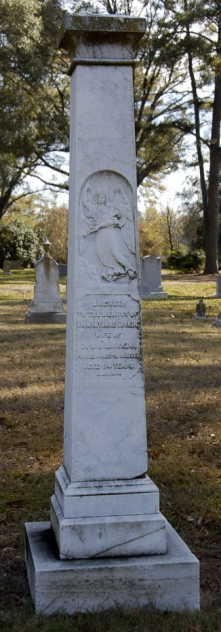
There were 5 Larkin children born, and Polly died in 1862, and has a nice tall memorial stone (perhaps shared with other family members.)


Their children were:
John Robert Larkin 1834-1869
William J. Larkin 1837-1859
Porter Jones Larkin 1839-1878
Milton King Larkin 
Mary Narcisa Larkin 1844-unknown

Just a footnote to the Larkins. In the 1870 census another male child was listed living with Samuel Larkin (probably his grandfather) but someone didn't read about the two Larkins in their 20s, and attributed this boy to being the son, rather than probably a grandson of Samuel Larkin.  That's how people are given strange relationships. I noticed right away (one of the first things I check in families) that Mary Jane Bass Larkin wasn't in child bearing age in 1870...and she'd died in 1862 anyway! Genealogy sure keeps one one your toes.

Saturday, September 7, 2019

Col. Richard Bass' sister Mosely (Molly Ann) Bass George.

Repost of a popular story from Thursday, April 26, 2018 on Immigrating families.

Here's a story (link below) about Rev. Elias George and his family who immigrated from Alabama to Louisiana, including perhaps my relatives.  The same road was traveled by them, at any rate, ending up in Union Parish LA.

My great great grandfather Col. Richard (Dick) Bass had a sister, Mosey (Molly Ann) Bass, who married Rev. Elias George.  Rev. George led a group of families to Louisiana in 1848 from Alabama.  Their daughter, the author of this story, Louisa (Lou) M. George, married Thomas Brooks Tompkins.

Louisa (Lou) M. George Tompkins was the granddaughter of Julian Holloman Bass Green, (also Col. Richard Bass' mother - former post here) so she was my first cousin 3 times removed.

1848 "The caravan included about 50 covered wagons, carriages, carry-alls, and buggies."

This is the story, told by my 84 year old cousin, Louisa (Lou) George (Tompkins) in 1926.  Come on over and enjoy her tale of life in the South before the Civil War. Put your feet up and read through the intense story she wrote.

(here)

I invite you to try some enjoyable historical reading about how those people living in Alabama trekked to Louisiana...with households and cattle and slaves, before the Civil War.  I think it starts when she was age 5, in 1847. It includes lovely descriptions of homes and surrounding land, friends, slaves, family members, sickness, schools, death and a life that she remembered well.

This was written by an elder at close to the end of her life, but speaks of how she had been a young girl. She was born 8 Feb, 1842 in Perry County AL, and died 23 July 1936, in San Jose, Santa Clara County, CA.

The person who shared her fascinating story onto Ancestry (Chuck Kinison) said:
"These should not be copied but read for information and pleasure.  Her memoirs are a treasure."
http://files.usgwarchives.net/la/union/bios/tompkins.txt

From the story of Lou George Thompkins...
"After moving into this newly built forest home, five miles from town, my two oldest sisters, Lizzie, 15 and Sue, 13 attended school in Marion, boarding at the 
home of mother's brother, Uncle Dick Bass.  The 
carriage was sent for them Friday afternoons, and took them back early Monday mornings."

I just discovered that Uncle Dick Bass was none 
other than my gg grandfather Richard Bass. Yes, 
he was living in Louisiana at the same time! And 
now I know his family called him Dick!

Lou George Tompkins and sister Linnie (Melina Elliot George Dirking)

(I don't know which one is which. but I think Linnie was 3 years younger than Lou.

Their sister Susan also has a portrait photo published on Ancestry.  
Susan Sophia George Thomas 1836-1928
** A comment on the original post gave this information:
"Rev Elias George had himself appointed guardian of the minors (infants) of John Bass and Julia Ann Holliman, and subsequently married the oldest daughter Molsey Ann Bass."

In other information, (on Ancestry) Richard Bass, the youngest, was part of the family with step-father Jepson Green who married his mother. I don't know which is accurate.

Friday, September 6, 2019

The Bass siblings of Col. Richard Bass, the Bartons and Traylors

More of a series about the Bass family, which started with my great grandmother, (Elizabeth) Bettie Bass Rogers.

Bettie Bass Rogers' father, Col. Richard Bass had 6 full siblings and a half-sister. Their parents were John Bass (1775-1822 and Julian/Jullia Ann Holloman Bass (Green) (1785-1861).

I'm including a previous post here, in case it seems like you've read it before!

Richard Bass' older sister, Elizabeth Bass was born on 9 Oct. 1810 in Wayne County, North Carolina. She had 2 older siblings also born in NC, and then the Bass family moved to Perry, Alabama, probably for a land grant.

The 5 younger siblings of the Bass family were born in Alabama, and I started with an older sister who had an interesting photograph (I think) of the couple.  Cloud Thrasher Barton and his wife Elizabeth Bass Barton.  Cloud's real name had been Claude, when he was born in South Carolina on June 3, 1804 in Pickens, Pickens County SC. If you've ever heard the South Carolina accent, it's not surprising that his name became Cloud...which probably didn't sound much like it's spelled anyway!


When Elizabeth Bass was 10, her father died with a lot of debt, and there are various court records as to how his brother-in-law, wife, and a neighbor, Jetson Green, would take care of the farm, and the children.  Jetson Green married the widow (Julian/Julia Ann Bass) three years later, and then was step-father to the Bass children.  My great great grandfather was the youngest, having been born in 1819.

Elizabeth Bass, or Eliza, as she was known, married Cloud who had been the 4th of 12 children of his parents, the marriage taking place in 1837 in Perry, Alabama.  It was Cloud's second marriage, having earlier married in Georgia. I have no details of that first marriage.

Within 3 years the Barton family relocated again to Caldwell Parish, Louisiana. They had 8 children, with another move of the family to Moorehouse Parish, LA.

Eliza died in 1860, but Cloud lived a long life, dying at age 86 in 1890.  His last years were spent living with his adult children, as shown on census reports, in various counties in Texas.

I can't find any records that the Bartons were living near her brother, Col. Richard Bass and his family (my great great grandparents) when they both lived in Louisiana or Texas.  That's a lot of territory, and farmers were busy people.  But perhaps they did gather at the Green homestead where Eliza and Richard's mother, Julia Ann Bass Green lived until her death in 1861.

Richard Bass' first 4 children were born in Morehouse Parish, LA before the death of his sister Eliza in 1860...so perhaps the children knew their aunts and uncles and cousins.  One daughter born to Richard and his wife, Mae (Mary Ann Powell Bass) in February of 1860 was to become my great grandmother, Elizabeth (Bettie) Bass Rogers.  Her aunt Eliza Barton didn't die until Oct. 18 of that year, and I like to think that my great grandmother was named "Elizabeth" after her.

The other siblings of Col. Richard Bass? (another repost)

The connections within families include many cousins who marry in small communities. But this time I found an uncle who married a woman's sister-in-law.

So today let's go back to the Bass family, once they got to Marion, Union Parish, Louisiana. (and I am reminded how the Parish was divided, and different names given to same places as the Parish grew and changed into smaller Parishes through the years.)

My great great grandfather was the youngest son of John and Julian Holloman Bass.  I call him Colonel Richard (Dick) Bass. (He did fight for the Confederacy under Mississippi troops, but may not have been a real Col.)

He married Mary Ann (Mae) Powell Bass.

Her parents were James Moore Powell and Nancy Jones Traylor Powell.

Col. Richard Bass had an older sister named Keziah (or Cozzie) Bass. She married James M. Traylor Sr.

He was the brother of her grandmother, Nancy Jones Traylor Powell, or Uncle to her mother, Mae Bass.

So Mae Bass' mother's brother married her husband's (Col. Dick Bass') sister.  I wonder what they called each other!

I've enjoyed seeing Traylor children on census reports for Bass families, or Powells, often because parents had died or needed to have them live with other families.  Unfortunately early census reports didn't say what the relationships were to heads of households...but they learned to add that after a while.

I posted a bit about Col. Richard Bass back on Friday, January 3, 2014. Here, and again this week.

Sharing with Sepia Saturday this week.


Wednesday, September 4, 2019

Col. Richard Bass

A repost from 2014:

Richard Bass was born in Perry County, AL on 3 JAN 1819.  He was the father of my grandfather's mother, Bettie Bass Rogers.  He served in the Confederate army in Mississippi (from Texas).  (Source: Historical Data Systems, comp.. American Civil War Soldiers [database on-line]. Provo, UT, USA: Ancestry.com Operations Inc, 1999. Source 425.)


His father's estate had a petition against it which gives Richard's birth as 1814.  This date is not corroborated by his census data as well as his grave marker which all reflect an 1819 birth.  So the legal petition in Alabama was probably wrong, but it may have helped in some legal sense for him to be of a different age..  Another source has him born in NC rather than AL.  Wherever he was born, he was the youngest of 8 children of his parents, and his father died when he was very young, and he was raised by a step-father. His mother was Julia Ann Holloman Bass Green.  Father was John Bass, both from Wayne County, NC.  His step-father was Jetson Green, who raised him from when he was around 6 years old. (NOTE: I haven't found anything to substantiate this, besides court documents by Green asking for guardianship...not receiving it, but he did marry Mrs. Bass.)

He married Mary Ann Elizabeth Powell on 12 Oct, 1839 in Perry AL, at age 20.  They moved to Louisiana, Union Parish, by the time he was 30, according to the 1850 US Census records.  The birth places of his children put that move between 1841 and 43.

Then the family moved again, according to 1860 Census records, to Walker County, Texas.  His age is listed incorrectly as 20, though he is definitely 40.  At the cusp of the Civil War he was middle aged.


Downtown  Huntsville, Walker County, Texas 1870s
Next census for 1870 shows him in Walker County, working as a merchant, rather than a farmer as he had previously identified himself in census reports.  Being a merchant meant he probably lived closer to a town at this time, perhaps Waverly, where he died.

I mentioned his children as siblings of Elizabeth "Bettie" Bass yesterday.  Most of the Bass children were born in Waverly, Texas or Walker County, Texas.

Col. Richard Bass died 5 May 1880 in Waverly, Walker County, TX, where he is buried.  The Handbook of Texas History says
In 1986 all that remained of Waverly was a cemetery, a nearby Presbyterian church, and a rural subdivision called Old Waverly, which had a population of about fifty people. Texas historical markers were erected for Old Waverly in 1969 and for the Waverly Cemetery in 1978.
More information about the settlers moving to Waverly includes this:
In the autumn of 1852 some 300 people from Alabama, including slaves, moved into the Waverly area. The town was surveyed, mapped, and incorporated in 1858. According to popular legend the town was named for the Waverly novels of Sir Walter Scott. Some considered Waverly to belong to the South of "moonlight, magnolias, and landed gentry." In reality it was a small enclave of the slave-plantation system imported from central Alabama. Waverly Institute, consisting of a male and female academy, was established in 1856. A post office operated from 1855 until 1872. A Masonic lodge operated from 1861 to 1865, and Methodist, Presbyterian, and Episcopalian congregations were started in town.
What became of the tiny town?
In 1870 San Jacinto County was formed from a part of Walker County, including the Waverly area. At that time Waverly leaders, in fear that the Houston and Great Northern Railroad would bring "tramps and ignorance to the town and kill cattle," refused to give the railroad right-of-way. In doing so they ensured the rapid demise of Waverly. The town of New Waverly was established ten miles west of Waverly in 1870 to take advantage of the railroad and became a prosperous town .
A bit more information can be found here...about Waverly, Texas. 

I've posted about his wife, "Mae" Mary Ann Powell Bass HERE.

Thursday, February 21, 2019

Mary Ann Powell Bass birth anniversary

A repost of my blog on the 2014 anniversary of her birth! She was born 194 years ago this year.

Mary Ann Elizabeth Powell Bass

Mary Ann Elizabeth Powell was born on 21 Feb 1825 in Perry, Alabama, where her father had received a land grant from his service in the War of 1812.

She met and married (at age 14) Richard Bass (later to be called Col. following the Civil War) in her home town, (see Here for more on him) but they started a migration to Texas, stopping along the way for several years. By the time she was in a census at age 25, she had a daughter, Julia (9) born in Alabama, and a son, James (7) born in Louisiana, and daughter, Ellen (5) also born in Louisiana.  That census of 1850 showed the family living in Union Parish, LA.

In the 1860 census the family lived in Walker County, Texas, with a 5 month old baby Elizabeth, who was born in Texas.  Ellen is no longer listed, and another daughter, Nancy C. is 6 years old, born in Louisiana.  There's a cousin living with the family as well, whose name is Emily W. Traylor.


What is interesting about both the Union Parish LA census and especially the Walker County, Texas census, is the listing of various relatives along the same road...all farmers at this time. I'm pretty sure her parents lived on the next farm, but her younger brother who was a physician is also in the neighborhood.  

My great grandmother, Elizabeth "Bettie" Bass Rogers was born in 1861.  (More about her HERE)

Mary Ann Powell Bass died on 12 Oct 1871.  If the Ancestry.com family tree is to be believed, she had 4 more children before her death at age 46.   (Editor's note: only 3 more children were born to Mae...see correction of Bass family published soon.)


Here's her headstone in the  Old Waverly Cemetery.,Walker Co., Tex

Her parents were buried nearby, James Moore Powell (27 Feb 1791 Bertie County, NC - 27 Feb 1868, Walker County, TX) 
and Nancy Jones Traylor Powell (16 May 1804, Oglethorpe County, Georgia - 27 Jun 1881 in Old Waverly, Walker, Texas)  

James Moore Powell (1791-1868)

Nancy Jones Traylor Powell 1804-1881

Thursday, May 3, 2018

Family connections in the old south, Bass family etc.

The connections within families include many cousins who marry in small communities. But this time I found an uncle who married a woman's sister-in-law.

So today let's go back to the Bass family, once they got to Marion, Union Parish, Louisiana. (and I am reminded how the Parish was divided, and different names given to same places as the Parish grew and changed into smaller Parishes through the years.)

My great great grandfather was the youngest son of John and Julia Ann Holloman Bass.  I call him Colonel Richard Bass (though he was probably an honorary Colonel in the Civil War.)

He married Mary Ann (Mae) Powell Bass.  Her parents were James Moore Powell and Nancy Jones Traylor Powell.

His (Col. Richard Bass') older sister Keziah (or Cozzie) Bass married James M. Traylor Sr.  He was the brother of Nancy Jones Traylor Powell, or Uncle to Mae Bass.

So Mae Bass' mother's brother married her husband's sister.  I wonder what they called each other!

I've enjoyed seeing Traylor children on census reports for Bass families, or Powells, often because parents had died or needed to have them live with other families.  Unfortunately early census reports didn't say what the relationships were to heads of households...but they learned to add that after a while.

I posted a bit about Col. Richard Bass back on Friday, January 3, 2014. Here.

On Feb. 21, 2014 I posted about the census reports and the immigration of the Bass family to Texas through Louisiana, HERE.

Belle d'Arbonne, Union Parish Louisiana


Union Parish LA cemetery


Thursday, April 26, 2018

Immigrating families

Here's a story about Rev. Elias George and his family who immigrated from Alabama to Louisiana, including perhaps my relatives.  The same road was traveled by them, at any rate, ending up in Union Parish LA.

Louisa (Lou) M. George Tompkins was the granddaughter of Julia Ann Holloman Bass, (yesterday's post here) so she was my first cousin 3 times removed.

Her mother was my great great grandfather's sister.  GG Grand was Col. Richard Bass.  His sister was Mosely (Molly Ann) Bass George, who's husband,  Rev. Elias George, led a group of families to Louisiana in 1848.  Their daughter, the author Louisa (Lou) M. George, married Thomas Brooks Tompkins.

1848 
"The caravan included about 50 covered wagons, carriages, carry-alls, and buggies."

This is the story, told by my 84 year old cousin in 1926.  Come on over and enjoy her tale of her life in the South before the Civil War.

(here)

I invite you to try some enjoyable historical reading about how those people living in Alabama trekked to Louisiana...with households and cattle and slaves, before the Civil War.  I think it starts when she was age 5, in 1847. It includes lovely descriptions of homes and surrounding land, friends, slaves, family members, sickness, schools, death and a life that she remembered well.

This was written by an elder at close to the end of her life, but speaks of how she had been a young girl.

Born: 8 FEBRUARY 1842  Perry County, Alabama

DIED: 23 JULY 1936  San Jose, Santa Clara County, California


The person who shared it onto Ancestry (Chuck Kinison) said:

"These should not be copied but read for information and pleasure.  Her memoirs are a treasure."
http://files.usgwarchives.net/la/union/bios/tompkins.txt


Lou George Tompkins and sister Linnie (Melina Elliot George Dirking)

(I don't know which one is which. but I think Linnie was 3 years younger than Lou.

Their sister Susan also has a portrait photo published on Ancestry.  

Susan Sophia George Thomas 1836-1928

Contributing to Sepia Saturday this week, in honor of many of my ancestors who left all they knew and loved, (and perhaps dangerous circumstances) and entered into the perilous adventure of traveling to a new place to live.

The prompt shows:

Sepia Saturday 416 : 28 April 2018
Helsinki residents waiting for evacuation at the railway station. (1939)
TRAVEL  :  WAR  :  EVACUATION