description

My own life and my opinions are shared at When I was 69.

REMEMBER: In North America, the month of September 1752 was exceptionally short, skipping 11 days, when the Gregorian Calendar was adapted from the old Julian one, which didn't have leap year days.

Wednesday, January 12, 2022

Out of the past - second chapter of photos out of the album


I just edited this old photo of me at around 4 years.

I married my Coast Guard husband  and won't even say the date. He was handsome to me. I was only a military wife for a couple of years. Our first son was born in a Naval Air Station hospital.


About a week after my son's birthday, my whole family came to Texas from St. Louis...parents and sister. She is enjoying the Gulf of Mexico here, and had just graduated from high school. 


It's pretty grainy to try to enlarge her, but this gives you a better idea of how she looked.


It's always fun to point cameras at other photographers. Here is my dad captured by my husband looking over the parental car. Yes they had driven the thousand miles to meet their first grandbaby. We lived up those stairs in the apartment behind my dad. We found a downstairs apartment a few months later!

After our second son had been born in Connecticut we moved to FL. So here I am skinny again drying off after a dip in the pool, with my parents visiting at a motel near Tampa. Dad has his back to the camera, while Mom sits in the far background in her shades. Oldest son is reaching for something on the table, while youngest is facing toward him on the other side. He's about 2.

More about our nautical life in the next post. (Not very much actually.)


Tuesday, January 11, 2022

From my past

 These old photos were in an album which frankly had seen better days. Many of the exposed photos stuck to each other where they were on facing pages. I also had culled many of the photos of my sons and given them new locations in cardboard albums, behind a plastic transparent screen. I don't know what has become of those, because they were gifts to my three sons. 

I found strangely enough that some photos had been added much later of my third son, who of course hadn't been around for most of the early events.

Anyway, I've spent several hours scanning and organizing them. The only ones I'll share here are ones that represent more than just my family. These represent places and events as well as people that may have died.

So to start, let's see about my own birth.

This is not an official birth certificate, and I've taken off my dates and my mother's maiden name, which might be of use to somebody wishing to steal my identity. Those footprints sure won't help them! 

I was a pretty long baby at 20-1/4 inches. I don't know if the other stats are at all unusual.

It's a cute document with a gold seal. After I scanned it I tore it up and threw it away. Who would want such a thing? It's not legal!


This shot, from the infamous Kodak box camera, shows I could sit up by the time I was 7 months old.
I think I have a heart locket on. And there's a bent-wood chair behind me on the front porch in Dallas TX. Date on the back says March 21, 1943


And I liked to give my smile to the photographer. I like this shot showing the bassinette. And the lovingly knitted cap and sweater by my grandmother. Dated March 17, 1945

Last shot from March 1945. It was wartime, and I think the car parked in the next driveway was our neighbor's. All cars were black then. And they had this awful brown/grey upholstery. (Well that was my memory anyway!)

And I just realized that because I had all boys, I had kept my old knit bonnet tucked away somewhere because of course it was pink! I didn't have a chance to give it to any granddaughters either, because they didn't live where it was cold.   But I did find it still where I tucked it. No moths have gotten to it either, amazing over all my moves and 79 years.


It did bring tears to my eyes, thinking of my dear grandmother whose fingers made these stitches. Love can be carried through the years in strange and beautiful ways.

Fast forward...next post I'll bring some other family members here!

Saturday, October 30, 2021

B & W Photos of yesteryear, and some histories


Mary McCloud Bethune was born on July 10, 1875

She started a school for African-American girls with $1.50. The school bordered the town dump. Make-shift desks and chairs were made from discarded crates and boxes. There were five students at the time, and the students made ink for pens from elderberry juice and pencils from burned wood.
When the the local Ku Klux Klan heard about the school, they threatened to burn it down. There were reports that they waited outside the school, but she stood in the doorway, unwilling to back down or leave her school. Other stories say that she and her students started singing spirituals. The Ku Klux Klan eventually left.
Mary McLeod Bethune was born on July 10, 1875 in a log cabin on a cotton farm in South Carolina, the 15th of 17 children of former slaves. Most of her brothers and sisters were born into slavery; she was the first child born free. She started working in the fields by the age of 5.
This is a post from the Peace Page, with information compiled from historical sources online. The Peace Page encourages readers to learn more of the life of Mary McLeod Bethune online.
One day, she accompanied her mother, delivering “white people’s” wash. When she was given permission to enter the white children's nursery, she saw a book, which fascinated her. A white girl would quickly snatch the book from her hands, telling her she didn't know how to read. That's when Mary realized the only difference between white and black folk was the ability to read and write.
When she got the opportunity, McLeod attended a one-room black schoolhouse, walking five miles to and from the school. When she got home, she would teach her parents and siblings what she learned. She then got an opportunity to attend the Moody Bible Institute in 1895, becoming the first African American student to graduate from the school.
She decided then she would become a missionary, sharing what she learned. But, she would be informed that no one wanted or needed a black missionary.
Rather than give up her dreams, she decided more than ever that she would eventually teach.
Flash forward to 1904, when after moving to Florida, she started the Educational and Industrial Training School for Negro Girls, which initially had five girls aged six to twelve. With limited resources, she was determined to make the school a success, even when the Ku Klux Klan threatened her. But, eventually she received donations and support from the community, and the school grew to 30 girls by the end of the year.
Booker T. Washington would tell her of the importance of white benefactors to fund her school, so she started traveling and fundraising, receiving donations from John D. Rockefeller and establishing contacts with Franklin and Eleanor Roosevelt.
Her little school would become even more successful after it merged with a private institute for African-American boys and became known as the Bethune-Cookman School. She was president of the college from 1923 to 1942, and 1946 to 1947, becoming one of the few women in the world to serve as a college president at that time.
After she found that one of her students needing medical care was denied the care she needed and was placed on an outside porch of the local white hospital instead of a room with a bed, she used her funding sources and connections to open the first black hospital in Daytona, Florida.
According to the Turning Point Suffragist Memorial Association, McLeod became "one of the 20th century’s most powerful and celebrated advocates for civil rights and suffrage", holding "prominent roles, including president, in the National Association of Colored Women (NACW). She also served as president of the Florida Federation of Colored Women’s Clubs, where she fought against school segregation and sought healthcare for black children. Under her leadership, the National Council of Negro Women (NCNW) was founded as a unifying voice for African American women’s organizations."
As chapter president of the Florida chapter of the National Association of Colored Women, she would become so well known for her work registering black voters that once again she received threats from the Ku Klux Klan. And, like before, she did not back down.
With her friendship with the Roosevelts, she would become appointed as a national adviser to president Roosevelt, becoming part of what was known as his Black Cabinet and advising him on concerns of black people and would be called the “First Lady of the Struggle”.
When she passed away on May 18, 1955, she was recognized across the country. One newspaper suggested "the story of her life should be taught to every school child for generations to come" and The New York Times noted she was, "one of the most potent factors in the growth of interracial goodwill in America."
In her own words before she died, she wrote:
"I leave you love. I leave you hope. I leave you the challenge of developing confidence in one another. I leave you a thirst for education. I leave you a respect for the use of power. I leave you faith. I leave you racial dignity. I leave you a desire to live harmoniously with your fellow men. I leave you a responsibility to our young people."
“If I have a legacy to leave my people, it is my philosophy of living and serving. I think I have spent my life well. I pray now that my philosophy may be helpful to those who share my vision of a world of Peace, Progress, Brotherhood, and Love.”
[Note: This was originally published on the Jon S. Randal Peace Page in 2019. You are welcome to share, but please do so via the Facebook share button which acknowledges the original author. Thank you.]

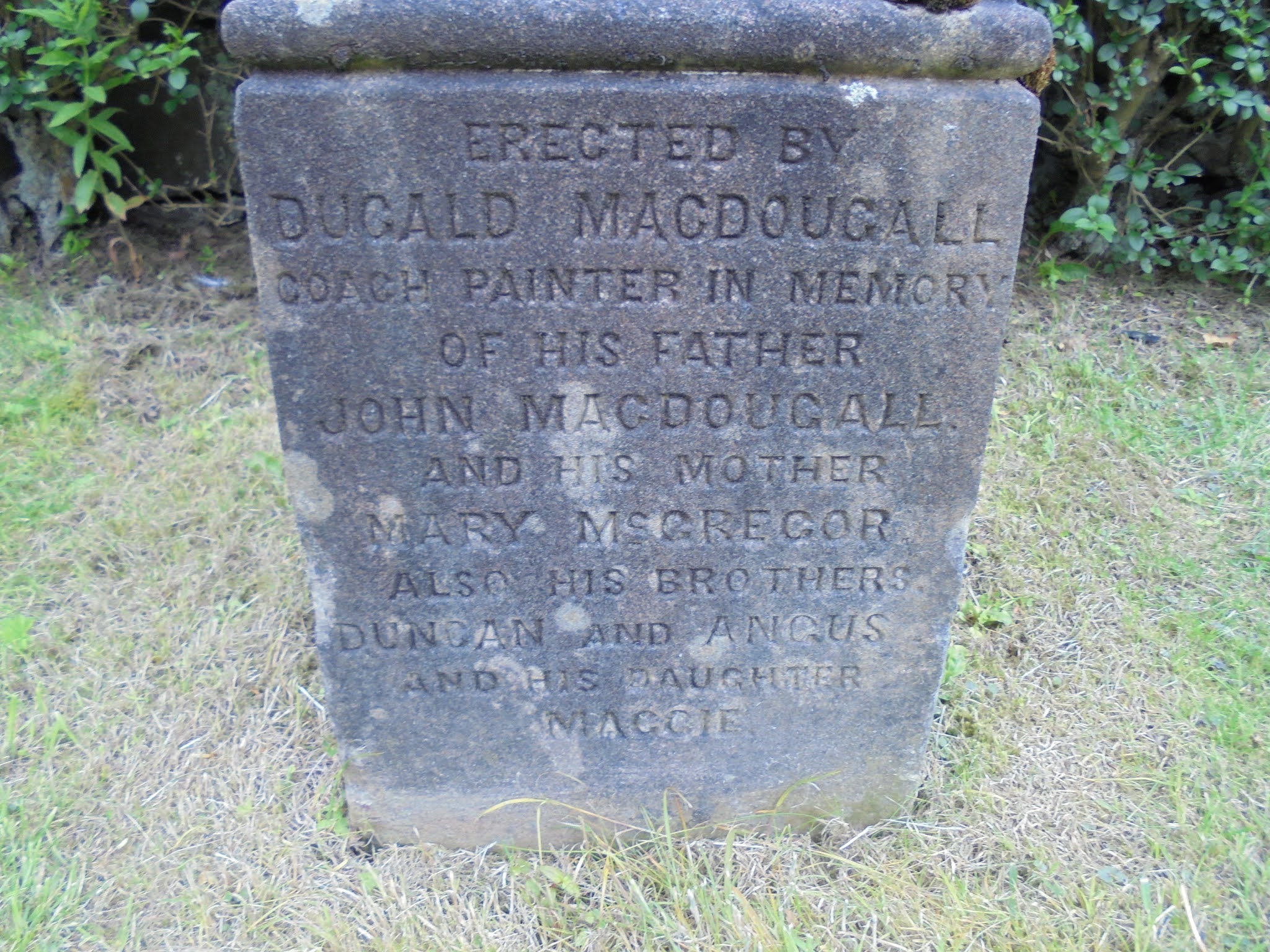
And as I've looked into my own ancestors' pasts...I found that I've a drop or two of Scottish blood...namely from Dugald and John MacDougall

This carving is the base of the memorial depicted below, out of focus.


In my Ancestry tree, WIlliam McElhany (1766-1815) of Pennsylvania, fought in the War of 1812, on the American side.

His memorial is in the Cheektowaga Historical Cemetery site. I posted about the cemetery before HERE..

Soldiers who died in the military hospital were buried in the cemetery on Aero Dr. which was located in Amherst until the New York State Thruway was built nearly 150 years later, when the cemetery became part of the Town of Cheektowaga.

Graves are not individuality marked, there are small white wooden cross's scattered throughout the cemetery.

Established: 1814 - 1815, aka Old Military Cemetery, aka Garrison Road Cemetery, aka Creek Road Cemetery .

Denomination: Military

Address & Location: Located on the south side of Aero Rd., between Transit Rd. and Wehrle Dr., west of Youngs Rd. (North of Buffalo International Airport). 

William McElhany's wife was Elizabeth Clark McNeal McElhany (1768-1849) and her ancestors included members of the families McNeal, McKorda, McKinney, and many a Scotch-Irish family.

One grandmother was Mary Sarah MacDougall, 1664-1725...who's lineage included MacLaughlin, Livingstone, Gillespie and her father, Alexander MacDougall.  He was the 21st Chief of Dunollie and of Lorn, (1635-1695) of Dunollich, Argyllshire, Scotland. He would be my 9th great grandfather.

I'm not quite sure how the monument connects to him...and will try to figure that out in the next few ventures into Ancestry. I know only that she was my 8 time great grandmother, among the immigrants from Scotland to Ireland.

In the meantime I wanted to share two serious looking ladies, all squeezed up in their fine attire, ready to walk somewhere with beautiful parasols.  I don't think I'm related, and don't even know their names.

Sharing with Sepia Saturday this week!


Today's quote:

“It is not work that kills men; it is worry. Work is healthy; you can hardly put more upon a man than he can bear. Worry is the rust upon the blade. It is not the movement that destroys the machinery but the friction.” ~ Henry Ward Beecher


Tuesday, October 26, 2021

Changes

 I love thinking how often things change...often without my knowledge or encouragement. Like my $80 increase in car insurance. And I never saw that coming. My car gets much older, and for some strange reason the insurance company thinks it's going to cost more to repair or replace. Well, the newer ones do cost much more, so I may never be able to replace it anyway. Let's see which one of us wears out first!

The change that I wanted to mention is one of my intentions to learn Gaelic...preferably the Scotts variety. I've got the book. But then someone suggested free Duolingo. So I've been working on that on line, very slowly...and I'm pretty sure it's Irish Gaelic.

I am ok with that. It's hard enough with vocabulary, but at least Duolingo does have sounded out words and sentences.

Whoopee! So every day or so I work on my vocab and the existence of male/female articles of the words that are at least clearly male or female. Like the girl, the boy, the man, and the woman. Then they get to eat, and I have to figure out how those sentences get put together. Over and over! And it's still like starting over again with each lesson.

Other than that, I've got lots of volunteer stuff on my plate so I'd best get to doing that!

Have a great day!


Saturday, September 18, 2021

Memory in old age

 We all suffer from some memory loss, and often joke about it. But when I consider, at the end of the day, that I spent about an hour when broken into all the different times then pulled together, when I was trying to remember something, I want to cut back on memory difficulties.

I've heard a good technique is actively learning something. Not repeating words as crossword workers are doing, or adding numbers as Sodoku workers are doing (though I think those are definitely work!) - and certainly not playing "find the..." games. I need to push myself to learn something new.

So I had to drop out of our Spanish Conversation class, thanks to a pandemic. I don't know how, but I want to learn Gaellic.

Then I found out there are 2 major ones, and probably one of those is broken into 3, and the other broken into 2 very different dialects...and they might not be able to understand each other's Celtic brogue.

Now I started to say, Irish would be good. But maybe Scottish would be a better idea.

Flag of Scotland

And I looked on some Irish pronunciation sites with common phrases, and geese, I couldn't remember one of them, even after saying them out loud. 

Well, I admit I seldom remember any names or phrases I had just heard, even by saying them.

This is going to take a lot of effort, and time (of which I have plenty daily, though not so much yearly).

So if anyone should have some good techniques or suggestions, please let me know. I think I'm going to see if any language learning tapes on CDs are available through the library. I need to repeat and repeat after hearing the correct pronunciation. Maybe one phrase a week...or one word!

My Irish ancestor was Francis Beattie, (1715-1791) But come to find out, he was also a Scottish man, with the Ulster Scotts...though the birth of fathers and grandfathers is confusingly either Ireland or Scotland.


But I had other ancestors who were Ulster Scotts...or Scotch Irish as they are now called.

So I think Scottish Gaelic is the way to go after all!

Wednesday, September 15, 2021

"The Winthrop Woman"

 I just finished listening to the audio version of this book. When I tried to read it many years ago, I lost myself and lost interest. But this time I was captivated by it.

It was a very long digital audio book, but I was supposed to be sitting with my legs elevated a lot, so it fit right into my life at this time. (A foot injury is still not treated, but I have appointments coming.)


 I really enjoyed getting to know Elizabeth Winthrop, an early colonist to America, whose uncle John Winthrop was a governor of Massachusetts for some years of his life. 

I had many relatives in early Massachusetts and Connecticut, but have no knowledge of all the trials and tribulations they went through until I read The Winthrop Woman.

Elizabeth had many problems in her life, and somehow surmounted them all. She befriended a First Nation Indian woman who appeared several times through the book.  Elizabeth has romances, religious doubts, and a large family.  

Though this is a historical fiction, the actual woman, Elizabeth Winthrop, existed and was cited in many records through her life...records which still exist. I don't know how many things have been inserted to provide links to these records. But she dealt with early Puritans, and politics during King Charles I reign and the revolution of Cromwell. She dealt with the Dutch who had different laws to be followed when she lived in Greenwich CT, which was on the border and eventually became part of the English Connecticut Colony.

I remembered an ancestor of mine had a sister (Ann Brinley Coddington, 1628-1708) who married a Connecticut governor, and just looked up her mention on my blog HERE. The Brinley sister married Gov. William Coddington (1601-1678), while my ancestress was Grissell Brinley Sylvester (1635-1687) who lived on Long Island. I had many ancestors who settled in Boston MA, Andover MA, Newbury MA, Sudbury RI, Hartford CT, and Stratford CT, from both my father's and my mother's ancestry.

I wish on a certain level that I still lived in New England, and had access to all the many documents which still talk of the early colonists.  Of course there are lots of resources on line these days and I find many hints on my Ancestry trees every time I look at them!

Thanks to fellow blogger, Vicki Lane who recommended this book.


Friday, September 10, 2021

More on Alice Harris Farnum Martin

 I don't know why I left Alice Harris Farnum's children out of my last post!

She and her first husband, Ralph Farnum I, had 7 children. His occupation that he had recorded on their passage to America said he was a barber. The first four children came with the Farnums from England, where they had been born. The next were all born in the Colonies. The last was John Farnum, (abt. 1640--17 June 1723.) His line four generations later brought a Sarah Farnum who married Jacob Granger, a line which extended from New England to Texas just before the Civil War...my grandmother's grandmother.

But another of Alice Harris Farnum's children, their oldest by the name of Mary Farnum, married Daniel Poore. And Mary and Daniel's family included a daughter, Martha Poore, who married Capt. John Granger. So it was their grandson Jacob who married Sarah Farnum.  I wonder if they knew they had some kind of cousin relationship. And I don't dare figure it out!

When Alice married a second time to Solomon, the ship's carpenter, Martin, they had 2 children. The first had probably not been Alice's son, having been born in 1645 when she was married to Ralph (I presume). The second was born in 1648, after the date of her marriage to Solomon Martin. But we don't have a date of death for Ralph Farnum, just that it was before Alice married Solomon in 1648. So both of these Martin children could have been hers. Then Solomon died in 1655. Alice herself may have died in1652 as some Ancestry trees say, or may have lived until 8 Jan. 1691. Many of her children lived past that date, so she would have had someone to care for her in her old age.