description

My own life and my opinions are shared at When I was 69.

REMEMBER: In North America, the month of September 1752 was exceptionally short, skipping 11 days, when the Gregorian Calendar was adapted from the old Julian one, which didn't have leap year days.

Saturday, September 7, 2024

Chapter two of Ancestors of interest

Yesterday we left off with hearing Louisa George report of the yellow fever taking servants as well as  more dear ones. To continue... 


 Our father and mother were almost overwhelmed with grief.  Three good
servants were dead and three children were expected to die at any time.  But
the cup of sorrow was not yet full and once more the death angel appeared,
taking our faithful, devoted, and precious mother.  
 
 She had been for the last time to see her sick servants.  She found the maid
dead and the cook in a dying condition.  Mother prayed with her and comforted
her as best she could.  Upon leaving, Julia put her arms around mother' s neck
and said, " Miss Ann, meet me in heaven" .
 
 The next day mother was not feeling well, but did not go to bed.  That night,
she had a congestive chill, and at four a.m., she went to meet Julia in
heaven.  Her death was so sudden and unexpected, that father was beside
himself with grief and for several months the physicians were afraid he would
lose his mind.
 
 We three children were now wholly dependant on relatives, friends and
servants.  Although mother died in a room across the hall from where we were,
we knew nothing of her death till three weeks later.  The first thing that
seemed to call me back to consciousness was brother Elias crying and begging
for mother.  Father was holding him on his lap and when he continued to plead,
father burst into tears and told him mother had gone to be with God in heaven. 
With this explanation my brother ceased to call for her.  I was too weak, I
suppose, to realize the meaning, and never did until we moved back home to
begin life anew,---without our dear mother and faithful servants.
 
 I grieved for mother and Sarah, the girl who was my competitor in knitting.
(End of the original page cut off).
....all the time.  Sometimes I wanted cube sugar, and another time, brown
sugar; and again it would be sugar cane.  Once, I wanted oranges,  but none
could be had, even in Monroe, which was 60 miles away.  But I could not be
reconciled, and father sent Carter, the carriage driver and gardener to
Lakeport on the Mississippi River, over 100 miles away and told him not to
come back without oranges.  It took three or four days for the trip, but when
he returned with plenty of large, sweet, juicy Florida oranges, I feasted on
them till I was satisfied.
 
 Beginning to walk a little, I decided I wanted to go to Aunt Caroline's, and
seeing that I was determined, Mammy Chloe took me up on her shoulder and
carried me over.  Dear old Mammy Chloe,---how I loved her.  Right here, I want
to say that she nursed me when my first child (Paul) was born in my father's
home where we were living during the Civil War.  Mammy died during the War.
 
 Aunt Caroline let me stay as long as I desired (several weeks), and when the
last strand of hair disappeared from my head, she knitted me a black silk cap. 
She also bought some red, green, and white material for a quilt and taught me
how to sew the squares together into a double-chained square.  This was a very
wise thing to do, for I was very irritable and discontented, but upon getting
busy with my quilt, I was no longer any trouble.

(Note: Aunt Caroline was Rev. George's younger sister, Caroline Holt George McAdams, (1822-1887)
 
 As I grew stronger, my greatest joy was in the garden.  It was now Autumn,
and the chrysanthemums were in greatest profusion.  I had been with mother
when she superintended the planting of these flowers.  There was a cozy nook
with a cape jasmine bush on one side, a frame of honeysuckle vines on the
other, and in the rear, a frame of Marshall Neal roses.  Here, it seemed, I
could realize her presence more than anywhere else, and I was comforted in my
quiet solitude.  But I missed her more than anyone could realize and my heart
ached with its longing, finding relief in tears.  Sue, who was now 14, took me
under her wing and looked after my every need and ever after maintained that
same motherly interest, which endeared her to me more than the fondest, most
devoted sister.  She is still living in her old home in Marion which she and
her husband bought soon after the Civil War.  She was 90 years old last
January 6th of this year (1926).  (end of original page cut off)

(NOTE:Sister Sue was Susan Sophia George Thomas, (1836-1926) who would only have two sons of her own, one of whom lived to be an adult)
(Here we're hearing about the slaves...)
 
...can realize the strong personal attachment which exists between them.  The
fact of ownership and responsibility on the part of one, and the childlike
dependence of the other formed a mutual love, akin to parent and child; the
parent to control and the child to obey.
 
 We were indeed a sad family.  My oldest sisters (Lizzie and Sue) had to leave
school to be at home with us four younger children,---three of us still
invalids, though slowly gaining in health.  Sue and Lizzie were children in
experience but brave, dear sisters who did what they could.  The new
house-servants were untrained for domestic work but they were good and willing
to learn, and under the supervision of father's sister, Aunt Caroline McAdams,
who lived on a high hilltop nearby, they became quite proficient.  Aunt
Caroline was a widow with one daughter and three sons, and she did all within
her power to mother and care for us.  We saw little of father; he was so
stricken, yet he saw that we had everything needed.  He was so depressed in
spirit that he stopped building the house in Marion.
 
 Besides Aunt Caroline, sister Elizabeth cared for us four younger children. 
The youngest, Linn was four years old; Elias, 6; I, 8; and Jane, 10.  Lizzie
was a good sister, fond of reading, study, and music.  A new piano at this
time was company for her and Sue.  They did what they could for the happiness
of all and we were a peaceful and harmonious household.  But we missed our
family worship which mother never neglected, nor father, when he was home. 
But now he stayed on the farm with the overseer, coming home occasionally to
see that all was right.
 
 Father was troubled on all sides.  His good overseer, whom he brought with
him from Alabama, had also died and he hired another who understood very
little of superintending a large plantation of negroes and farm work. 
However, it was a good thing, even a blessing that father had to supervise
till the new manager was fully initiated into the routine of duties devolvent
on him.  The sight of his motherless children was a fresh stab of the dagger
to his poor bleeding heart.
 
 The three months' sickness left me no flesh nor strength. I was so emaciated
that they carried me around like a baby.  Dr. Traylor, the physician said I
could have all the sugar and sugar cane I wanted.  I kept a bowl of sugar on
the bed-table (bottom of original page cut off).
 
 
 THE MEMOIRS OF LOUISA GEORGE TOMPKINS
 PART 4:  SCHOOL DAYS

 A year had passed since dear mother left us and I was stronger, so father
decided to send Sue, 15; Jane, 13; and me, 9 to school and board us with Uncle
Dick (Bass, mother's brother) in Marion.  Sissy, now 17, had to stay at home
to look after Bud (Elias), 7; and Melinda, 5.
(NOTE: This episode takes place in Marion LA, not Marion AL.)
 
 I can't express the great delight and joy when I was permitted to go to
school, and to have a slate, book, and a pencil of my own; and to have a
lesson assigned me in Webster's Blue Backed Spelling Book
---one of which I have now, and which I treasure as a souvenir of my first
school days and which, like myself, remains alone,---a relic of the past.
 
 Marion was then a village of about 20 families, the most of whom were
prosperous farmers with plantations a few miles out in the country.  These were
cultivated by negroes and supervised by competent white overseers.  Though a
village in size, Marion had the finest school in north Louisiana.  The
principal was a highly accomplished lady from Virginia, and her sister was the
music teacher.  Their names were the Misses Harriet and Mary Whiting, and I
want to say that they were the best teachers I ever had,---even better than
those in the Judson College.
 
 There were only three of us in the primary class,---and the other two were
about my age.  All of us were ambitious to excel, and each of us was generally
perfect in lessons and deportment.  Occasionally, at the end of the month, one
would get an average of 99 (100 was perfect).  Then, for the other two there
would be much grief, but Miss Harriet would promise to cancel the failure if
we were perfect in everything the following month.  While at school I often
had chills and fever, but I could not be induced to go home to be doctored,
till Miss Harriet promised to give me my credits if I would study and recite
my lessons to Sue, who agreed to hear them and make faithful reports.  I would
often lie in bed and study while I had fever. 
 
 Doctor Traylor, father's family physician, finally took me from school and
kept me in his home for three weeks while he doctored and finally cured me. 
He was the father of Kate Traylor, one of my classmates and rivals.  He was
like a dear father and had Kate and me sleep in a trundle bed in his wife's
room.  I had every care, with a servant in an adjoining room to be called if
needed.  Kate and I were devoted friends until her death in Temple, Texas in
1914.  I had visited her the previous summer.  At this time I lived in San
Jose, California, and was returning from Marion where I had been visiting
Sister Sue.

(NOTE: Dr. Traylor was probably John Randolph Traylor MD, 1807-1864, my 3 times great uncle. The daughter closest in age to our Lou George was Sarah Katherine Traylor, 1847-1914. His wife, Sarah Simpson Traylor had been born in France, and they had 12 children together. Dr. John Traylor was brother of my 3 times great grandmother Nancy Jones Traylor Powell.)

 
 Coming back to school,---I began to take music lessons at the age of ten
(1852).  As I was very fond of music and liked to practice, it was not too
many months before I was in Class A,---out of 40 pupils.  We had a fine
teacher and her recitals, then called concerts, excelled those in larger, more
prominent schools.  At the age of twelve (1856) my teacher had me learn and
play at her recital, a solo with variations which the music teacher of the
College in Farmerville, the county seat, had played at one of their concerts,
for there was great rivalry between the schools.  At this time also, by my
father's request, my teacher had me play "The Battle of Buena Vista" , with
cannons, fife, drums, and battle raging.  Then I was the principal alto singer
and had to supply the need in duets and choruses, as well as in character
songs.
 
 I trust that you will bear with this egotism, by recalling that I am writing
my autobiography, and am speaking of self as of another person.  I reveled in
music and art and had made such progress in drawing and water colors that my
teacher often called upon me to help her in assisting and finishing the work
of her class which was too large for one teacher.
 
 School days in Marion were drawing to a close.  Our devoted teachers, Misses
Harriet and Mary Whiting, whom we all loved and respected, honored, and
obeyed, were leaving.  Miss Mary, the music teacher, married a lawyer and
located in Omaha.  Miss Harriet returned to Virginia and was later married.
 
 Our next teacher proved to be a failure,---many of her pupils being more
advanced than she in every way.  She was really a "back letter"  and did not
command the respect of her school.  Under our former teachers, we were taught
to be courteous and respectful to everyone.  We were required to be thorough
in each study, and we all seemed to be inspired with an ambition to be first
in our studies because we loved our teachers.  It was the difference between
these teachers that first gave me to understand that respect must go before
love.  Our parents soon learned their mistake and after one term, discharged
her.
 
 The next Fall (1856) father decided to send me and my two stepbrothers, who
were 16 and 17 years old, back to school in Marion, Alabama where there was a
large female college (The Judson) and male college (The Howard) of 300, and
each was a Missionary Baptist college.  We had been there only two months when
the boys were called to the deathbed of their mother who passed away soon
after their return.
 
 I remained throughout the whole term which closed with graduating exercises
and a concert,---the grandest it has been my pleasure to hear and in which it
was my privilege to have part in several instrumental numbers and choruses. 
The Concert, with all the closing exercises, was held in the city auditorium
and about 150 pupils took part.  The first piece on the program was the "Norma
March and Variations".  This was one of my numbers.  Nine pianos, arranged in
a circle on the rostrum faced the center where there was a full orchestra,
including an Italian harp.  There were 27 performers at the pianos---three at
each instrument.  I also played in another number with 18 performers at nine
pianos.  In a chorus called, " Scenes that are Brightest", 17 of us played
guitars which were suspended from our shoulders with pink ribbons.  The
principal of the music department was a German professor.  Under his
supervision were three music teachers (Ladies) of whose work and efficiency he
was responsible.  He had a musical family of five boys and girls from eight to
sixteen years of age, and each played a different instrument.
 
 We wore uniforms at Judson.  Our winter uniform was a green suit with a green
dolman for a wrap.  There was no jewelry, not even a breastpin for the collar,
which was of plain white linen pinned neatly at the throat, and there were no
low necks or short sleeves.  In summer, the uniform was pink and white.  At
the close of the study hour on Saturday night, the Governess, who was in
charge would tell us what we were to wear to church the next day.  One time,
it would be a pink dress and a white berege (fashionable dress material at
that time) talma (a circular cape with a bias ruffle).  Perhaps the next time
we would be told to wear a white dress and pink talma.  The bonnets were white
woven mohair, circling around the face and tied under the chin with a bow of
pink ribbon.  There was no trimming whatsoever, but they were lined with pink
and had a circular skirt of pink ribbon with narrow straw braid at the bottom. 
We wore these summer and winter.
 
 There was no difference shown with richest or poorest; all fared and shared
alike.  One a month, each girl was permitted to have fifty cents worth of
candy, nuts and fruit.
 
 The governess was not a teacher but had general supervision over the girls
out of school hours which were from seven to nine p.m. and from five-thirty to
six-thirty a.m.  She also supervised morning and evening study hours. 
Breakfast was at seven and school started at eight, with two hours for noon. 
School then began at two and closed at five.  From five to six, we were free
to play out in the beautiful grounds or park surrounding the buildings.
 
 The day began at five a.m. with the ringing of a large bell at the top of the
College, which was so loud that its peals could be heard all over the city. 
We sleepy girls had to bathe and dress as best we could in thirty minutes
before the school bell rang for study in the assembly room.  When the tap bell
was given for order and roll call, anyone not answering to his name was marked
tardy and received five demerits.  I always managed to be present, but once,
when I was not feeling well, I stayed in bed till the last minute, when I
jumped into slippers and study gown and with stockings in hand, rushed
downstairs to the study hall, reaching my desk just as the bell tapped for
silence.  That was the nearest I ever came to being tardy during the three
terms I spent there.
 
 When I first entered the College, I was assigned to the Junior Class.  The
first day I went to grammar class, they analyzed sentences, something I had
not been taught in our village school.  My teacher, however, told me to give
attention while (bottom of original page cut off).
 
 About a month later, father came to Alabama on business and visited me.  I
was so happy I cried for joy and became very homesick.  And since I was also
discouraged with my schoolwork, pleaded with him to take me home.  After much
persuasion he consented, and what joy!  I began that day to pack my trunk as
we were to start the next day.
 
 Bidding friends and teachers goodbye, we took the train the following morning
for Selma, where on the Alabama River there was a boat for Mobile and thence
we crossed the Gulf to New Orleans.  After spending several days in that city,
we boarded one of the finest and most popular boats at that time, the " Doctor
Buffington", which ran from New Orleans to Little Rock.  Her patrons were
mostly farmers and merchants.  There were so few railroads in the country that
all transportation was dependent on river navigation.  These were fordable in
summer but out of service to large steamers, except in the winter.
 
 The boat landed at nine a.m. on the third day of our trip from New Orleans
and five of us landed.  There was Hattie Bryant, a girl of my age, and two
young men from Marion.  Father went ahead on horseback to Marion which was ten
miles away.  Our baggage was sent in a wagon and we had to wait until father
sent the carriage for us.  But we started walking to meet the carriage and had
gone two miles before it approached us.
 
 (1858) I had not been home long when my father began to receive numerous
answers to an advertisement which he had placed in the " New Orleans Picayune"
calling for a school teacher and a music teacher.  He had me help him make a
choice.  From among the thirty or forty letters, I selected a mother and
daughter and this letter also suited father.  This he answered and a few weeks
later Mrs. Harrison and Anna Porter were added to our family.  They were all
that could be desired both as teachers and as companions.  Both were well-read
and quite intellectual.  Porter sang and played beautifully.  She was a fine
entertainer,---so full of life and vivacity and with never a loss for a word. 
The first time I ever heard "Kathleen Mavourneen"  was when it was sung by
her.  She and I became constant companions even though she was two years older
than I.  And what she was in companionship to me, her mother was to Sissy
(Sister Elizabeth).  They were both fond of reading and search for knowledge. 
Sissy often wrote continued stories for the "Boston Olive Branch"  and her
nom de plume was "Isabelle Gayle".  She also wrote for "Godey's Ladies' 
Magazine".
 
 Porter and I learned many vocal and instrumental duets which kept us in
practice and added pleasure and entertainment.  My life-long bosom friend,
Georgie Goldsby, was still at school in Memphis, Tennessee.  Her parents were
neighbors and dear friends of the family.  They had several children and the
oldest was a son named Miles; a very bright, intelligent, and handsome young
man, with no bad habits, such as tobacco, intoxicants, and swearing.  Although
he was generally admired, I cared very little for him.  He and Porter became
mutual admirers, which developed into stronger ties; but her mother, ever
watchful of her daughter's welfare, and being a wise and practical woman,
objected to anything further than mutual friendship.  The Harrisons suddenly
left Marion that Fall, but Porter left her heart behind.  This episode
resulted in the popular ballad, "In The Gloaming".
 
 After Porter and Mrs. Harrison left us, Sissy and I decided to move back to
her own farm called "OakLawn", a beautiful place which I shall describe at
another time.  There were many pleasant episodes at this delightful home and
my dear sister did everything possible for my happiness and welfare.  Georgie
Goldsby returned from Tennessee and we spent many pleasant months together. 
But the time came when Georgie and I realized that we were wasting golden days
in taking ease, comfort, and pleasure which could never return.  Our better
judgement decided us to return to school that Fall (1859) which was near at
hand.  Little did we think that the halcyon days of our close companionship
were drawing to an end.  She returned to her aunt in Memphis where she
attended college.  After graduating, she married a gentleman named Smith whom
I met.  He lived only a few years, dying in Memphis, and leaving her with two
little boys.
 
 At this time, I also, left for Mount Lebanon College in Farmerville,
Louisiana---a Baptist college of much notoriety at that time.  There was also
a large Baptist Male college in the same town, which my youngest brother,
Elias, 15, attended.  My youngest sister, Linn was with me at college.  The
Fall term opened September 1st of .(bottom of original page cut off).  
Our
president was named Prescott, a fine man of reputation as an instructor of
booklore.  Before taking charge of the female college, he was for several
years president of the male college.  The trustees elected him to the change,
hoping to have it established and managed on the same basis, rules, and
regulations as the Judson in Marion, Alabama.
 
 When Professor Prescott learned of my having attended the Judson School, he
requested me to assist him in formulating rules for governing each department,
just as they were at Marion.  All these he followed, except the uniforms,
which could not be adopted at that time.  In a few days, the school was in
order and all seemed to understand that it was a place for study and the
obedience to its laws,---and all were strictly enforced.
 
 On the first of October, the County Fair was opened in town for one week. 
Our school laws were suspended for the time and students were free to attend
it with suitable chaperons or escorts.  During that week, I made many pleasant
acquaintances, among them several very nice gentlemen,---one of whom I shall
specifically mention.  This was Doctor Key, son of Martin Key, a very fine man
who never forgot me after our meeting on this occasion.

------------------
NOTE: the following note came with the text as presented, where it changes to an observation of Louisa George and her future husband, Thomas B. Tompkins.
 
 Note:  At this point, the school days were brought to a close.  Dr. Key was
indirectly responsible for the romance between Louisa George and Thomas Brooks
Tompkins and the story will be told in another chapter.

=============
And there are some important changes coming into Sarah Louise (Lou) George's life soon.

1860s woman's dress

Friday, September 6, 2024

Ancestors of interest...chapter one

First, let's look at how she's related to me. I just like knowing the ancestors strings, tangled though they may be.

Sarah Louise (Lou) George Tompkins' mother, Mosley (Molly Ann) Bass George, 

b. 17 June 1812 in Perry AL, d. 17 Oct. 1850 Marion, Union Parish, LA 

was sister to my great great grandfather...


Col. Richard (Dick) Bass 

b.3 Jan 1819, Perry County AL, d. 5 May 1880, Waverly, Walker County TX.


so she was my first cousin three times removed.

This first part of her memoirs covers from her birth in 1842 to the yellow fever epidemic in 1850.

(I will use italics for my comments as Notes)


  THE MEMOIRS OF LOUISA GEORGE TOMPKINS

Union Parish, Louisiana

Submitted by Chuck Kinnison.

Sarah Louise (Lou) George Tompkins Specht
(WRITTEN IN 1926 AT THE AGE OF 84 YEARS) BY WAY OF INTRODUCTION To gratify the insistent desire of children, grandchildren, and friends, I shall begin a book of reminiscences. Some have suggested that an unvarnished life story, if frankly and simply told, might be of interest and help to others. In the careful introspection of my life I realize I have achieved so little; that there is not much to tell. Material for a book, the foundation of which depends on the gleamings from a "child's" life which began more than three-fourths of a century ago, will be mixed with much that is of little interest to anyone but the writer. While unraveling the threads that were used in the woven garment, many knots had to be tied, leaving the blemishes of neglected opportunities. Still, with the many imperfections, I am glad to say there are also happy reflections of the opportunities embraced. The seeming egotism in the book will be pardoned when it is observed that I am trying to give honor to the Great Friend who inspires the hearts of the willing and obedient. PART 1: THE FIRST HOME I was born on a farm near Hamburg, Perry County, Alabama in 1842. Elias George and mother, Ann Bass George, were the parents of nine children,--four sons and five daughters, of whom I was third from the youngest. All lived to maturity, married and raised families, except one brother, "Jeffy" , two years my senior, who at the age of eight years was thrown from a runaway horse. My parents were missionary Baptists, and we were early taught to reverence the name of Jesus, respect the Sabbath day, be kind and charitable to the poor, to servants, and to animals. There was family worship every night before retiring, and my mother would have the servants come in and to join us at such times. We were a happy family because children and servants were taught obedience to those who ruled them. We loved our servants and they loved us. My father, being a slaveholder, had a large plantation on which many supplies for home consumption were raised, such as corn, cotton, potatoes, barley, and peas. The home was a large, rambling two-storied building, and each of the various rooms had a fireplace. But the room that charmed me most was the nursery,--a large room with windows facing southward, overlooking the pasture, and in the springtime there was much interest in the horses and the little lambs as they chased each other and gamboled in the field. Our black mammy Chloe, was installed as guardian and caretaker of the nursery. Its inmates included three children, from one to five years old and two nurse girls, Mariah and Harriet, who were ten and eleven years old. The girls, under the supervision of mammy Chloe, would see to our bathing, dressing, and feeding. When the weather permitted, we were kept out doors in the sunshine and although the girls ran and played with us, our black mammy was ever near and watchful that no harm befell us. It is difficult to make it understood what love we had for Mammy and the girls. This attachment lasted even to old age. Mammy died just a few years (original sheet cut off). I would not have one think that our precious mother neglected her little children under these conditions and surroundings. She had duties devolving upon her, which could not be done by others. There were nine children to clothe and feed. While she had servants who cooked, washed, ironed and sewed, she supervised each department. There were no sewing machines nor ready-made clothing. We were strangers to most of the conveniences in common use today. Even soap and candles were made at the plantation. My father raised everything possible at home and a yearly trip to New Orleans resulted in the equivalent of a carload of provisions, dress goods from England or New England and many other things needed for the plantation. Oranges, apples, dried fruits, and candy were bought by the barrel. How well do I remember the picturesque surroundings of our home. There was a long sloping hill to the rear of the house, at the foot of which was a cold, gushing spring, and directed channels went forth to the house lot, chicken yard, and other needed places. A milk house was built over this spring, the floor of which was laid of large, flat rocks, so arranged that the stream was conducted over a channel two or three inches lower than the floor and wide enough to hold several pans of milk and butter. Our home was surrounded with mocking birds, swamp sparrows, field larks, whip-poor-wills, blue jays, and cardinals. They were never disturbed and consequently, many became quite tame, often feeding with the chickens, geese, ducks, turkeys, and peafowls. The whip-poor-wills could be heard at night in the swamp below, sometimes coming into the garden as though they wanted to serenade us from the branch of an oak tree near the house. I recall an evening twilight when one ventured on the lawn near the house-steps and called lustily " Whip-poor-will! Whip-poor-will!" and after satisfying himself, he flew to his companions in the swamp and soon the air was filled with their " Whip-poor-will"! and "whip-will, the widow!" Their concert lasted through the night, interrupted occasionally by the deep, sonorous voice of an owl loudly calling, " WHO! WHO! WHO! WHO! WHO! ARE YOU!". The loud laugh of another owl answered, " WAH! WAH! WAH!". I would often lie awake
(original page cut off) of sounds was inharmonious and weird; nevertheless, their
singing kept me from being lonely on wakeful nights.
 
 I can't leave this subject without taking you to the squabbery, which had to
be entered by climbing a stairway into a large room built in the poultry yard. 
It had hundreds of nests built in the wall.  I often went with Mary, the maid
to get squabs for breakfast and many were given to the neighbors.
 
 Other impressions of this home were the negro quarters which were a half-mile
from the house.  And there was a summer-house covered with coral and French
honeysuckle vines where the mocking birds often built their nests.  Also,
there were the flowers which grew profusely along the branch and filled the
air with their fragrance.
 
 These are the memories of my first home.
 
 THE MEMOIRS OF LOUISA GEORGE TOMPKINS 
 PART 2:  MIGRATION TO LOUISIANA
 
 
NOTE:  The first page of this chapter is missing.  She is evidently describing
the wonders of the new country in Louisiana which induced her father to sell
his home and migrate to Louisiana in 1848.
 
 _____________________contributant (bayous, creeks, and branches) flowing in
every direction, with cane breaks and swamps and filled with deer, bear
panthers, wolves; all of which helped to enhance the reports previously given
him by friends,---to say nothing of the natural growth of several kinds of
fruits and nuts.
 
 It is needless to say that the dear old home where my mother and father had
lived since their marriage and which had been the birthplace of their nine
children, was doomed.  Also, a beautiful new home near Marion, Alabama was
being completed.  This was a large, two-story house, quite modern in all its
appointments (for that time).  The inside work was superior to anything of its
kind today; the plastering was very hard and glazed.  The parlor and hall were
heavily frescoed around the edges of the ceiling, with a large wreath of
flowers in the center of each for the chandeliers.  My older sisters and
brothers were at the age when they needed to be in college, as they had
outgrown the country school.  To educate them had been the incentive for
building in Marion, as it was a residential city of schools and churches.
NOTE:The "beautiful new home near Marion, Alabama" was in Perry County AL, where they had been living. So it was a city home as compared to the plantation.
But to my father, nothing was too great a sacrifice for this "Land of Paradise" ,---not even the many friends and relatives with their earnest protests, or his popularity as a minister of the gospel. Nothing could outweigh his desire to possess a home in this unexplored wilderness---a venture of toil, self-denial, hardships, and untried experiences. Without taking it to the Lord in prayer, and seeking divine guidance of Him whom he served, he straightway sold his valuable plantation and lovely new home at a sacrifice, and was soon in readiness for the journey by caravan. (bottom of page of original cut off)
  parting with life-long friends, one of whom was her favorite sister for whom
I was named.  She had three sisters who were living in Louisiana, and also her
mother, near whom she expected to live.  But this pleasure could not
compensate for the pain of parting with that precious sister who lived but
three months more and whose death was mother's first great sorrow.
 
 Early in the spring of 1848, the day for departure arrived.  Three or four
families decided to cast their lot with us in going west, which at that time
was as far distant as is California now.  The trip had to be made in private
conveyances, drawn by horses and mules, and it would take weeks to reach our
destination.  Besides this, my father was taking with him 400 Durham cattle
which were to be driven by herdsmen.
 
 The caravan included about 50 covered wagons, carriages, carry-alls, and
buggies.  These and the horseback riders assembled at our home, and many
friends came to bid us "un bon voyage" .  How well do I remember that first
day, which to me seemed a gala affair with many more to follow.  I was too
young (six years) to realize what it meant to those on whom the burden fell,
nor what awaited us in the future.  The morning was bright and beautiful, and
although the sun gladdened the earth, it was unable to penetrate the gloom
which hung like a pall of dark foreboding in the hearts of some who
reluctantly bade a last farewell to loved ones.
 
 My mother rode in a carriage with four of her young children; a brother older
and a sister and brother younger than I.  The driver' s seat was high in
front, and in the style of the period, the nurse's seat was in the rear.  This
was supplied with a step or foot rest and arms, as with an armchair.  The
first day being cold and crisp, mother had the driver stop at a store as we
passed through Greensborough, and bought us children beautiful wool hoods and
each a tin cup, painted red and blue, with " Boy"  or " Girl"  stamped on it. 
These were suspended from our necks with ribbons.
 
 The caravan necessarily traveled slowly and when we children were tired of
riding, mother would let us get out and walk, always attended by the nurse. 
(Original page bottom cut off).
 
 Long before night, the captain, (father) always went ahead to find and
arrange for a suitable camp ground where wood and water could be obtained, for
provisions also to be made for the cattle as well as the teams of mules and
horses.  Having found such a place, he would wait for the crowd.
 
 The camp ground reached, the overseer of the negroes superintended the
location of wagons, tents, and animals.  The negroes' tents were grouped by
themselves and the white families were in a different location.  Each family
of negroes had its separate tent; each woman cooking for her own family, while
the men got the wood, attended to the feeding and caring for the stock and
pitched the tents.  There were log fires in front of family tents, and after
all were fed and the little children were in bed, the white families would
visit each other,---sit around and exchange experiences and jokes till nine or
ten o' clock.  The negroes would have their social time until the gong sounded
for retiring; after which quiet soon reigned, except for the occasional lowing
or neighing of an animal.  At five o' clock, the gong again sounded and all
were up and hustling with preparations to travel.  Then at noon, a stop for a
couple of hours was made, with rest and lunch for man and beast.
 
 We had to cross the Tombigbee River in Alabama which we found to be a
half-mile wide from recent rains.  It took two or three days to make the
crossing, for the cattle had to be ferried across.  Upon taking one load, the
cattle became frightened and stampeded, and several leaped from the flat-boat
and were carried by the swift current down stream, and two or three of these
were never recovered.
 
 Having surmounted this obstacle, we proceeded on our journey with nothing of
importance to note except that one night we camped in a lovely grove of oak
trees enclosed with a rail or worm fence.  A railroad track ran along the
outside of this enclosure, and we were warned not to cross the fence; that a
train would pass by very soon.  We hadn't waited long when a shrill whistle
heralded its approach.  We all stopped and gazed at the wonderful monster, as
it seemed to me, for in those days, railroads were rare to country people.
 
 At last we reached the Mississippi, which we crossed at Vicksburg on a
ferry (bottom of original page cut off) 
have been indelibly stamped on my
young mind.  We finally reached our destination which was a beautiful grove of
oak trees, in the midst of which was an eight-roomed cottage.  Also, there was
a summer-house covered with coral honeysuckle and woodbine and in the yard
there was an abundance of flowers.  My father had purchased this farm with 600
acres of improved land and under cultivation, to serve as a temporary home
until there were further developments.
 
 This home was three miles from Marion, a village in north Louisiana, in Union
Parish.  It was settled and named for Marion, Alabama by its earliest settlers
who had come from that place. 
 
 THE MEMOIRS OF LOUISA GEORGE TOMPKINS
PART 3:  THE FIRST YEARS IN LOUISIANA

 Father had bought 4,000 acres of timbered land within four miles of Marion,
which was to be cleared and converted into a plantation,---with cottages for
the negroes, a dwelling for the overseer, and with gardens and outhouses. 
This kept all hands busy for the first year, with only time enough to
cultivate the 600 acres of the home place.
 Soon after being installed in our new home, my second brother (Frank, 17) and
brother Jefferson, 8 years old, started to school in Marion, riding horseback. 
Coming home one evening, the horse ran away with them; the saddle girth broke,
and my younger brother was dashed against a tree.  He lived only a few hours. 
Brother Frank (cousin Onie's father) after lingering between life and death
for several days finally survived.  This was mother's second deep sorrow. 
Indeed, to all the family, it was the darkest day we had ever known.
 
 In the Fall of that year, a baby girl was born to my oldest brother's wife. 
On being told that I was its aunt, I rose several degrees in self-importance
in the fact that I, six years old, was an aunt.  Seeing sister Mat (baby
Josephine's mother) tatting, I gave her no rest till she had taught me how to
do it and I persevered till I had made about a yard which satisfied me for
that time, but I never forgot how, and often used this knowledge along the way
of life.  It was soon after this that mother taught me to knit.  There was a
negro girl of my age (daughter of the milkmaid) whom mother was training for a
house-servant.  She was also taught to knit.  Mother would measure off five
yards of thread; tie a knot; and when we had finished this task we could play
for a half-hour; then she would call us and repeat the task.  We would race to
be the first to finish and in this way we became rapid knitters.  At the age
of seven, we could each knit stockings from the beginning to the end without
help.  Mother would have us knit the winter socks for the negro boys who
worked on the farm.  The thread was spun at home from wool sheared from the
flock of sheep,---a flock of four or five hundred.  My father had bought them
with the farm also, many hogs.  There were numerous milk cows, some of which
gave a large bucket of milk twice a day.
 
 The next Fall, found that much had been accomplished in clearing and
building, and by the time winter had set in, all the negroes were comfortably
housed with large fireplaces in their cabins and good beds and plenty of wood. 
For our family, a temporary dwelling had been built about a mile from the
plantation on a high hill with a good spring of water, and to the rear of the
house was a branch running in a ravine.  In the spring many wild-flowers
filled the air with their fragrance.
 
 After moving into this newly built forest home, five miles from town, my two
oldest sisters, Lizzie, 15 and Sue, 13 attended school in Marion, boarding at
the home of mother's brother, Uncle Dick Bass.  The carriage was sent for them
Friday afternoons, and took them back early Monday mornings.
 
 The Spring following, father began to build a residence in Marion, having
purchased 25 acres of land with a bold spring and a branch of fresh water
flowing from it, which soon ran through the horse-lot and orchard, all of
which was prearranged when planning the home surroundings.  Our parents were
bending every effort to hasten the time when we could move to town and get
those old enough into school.
 
 But alas! alas!  " Man proposes but God disposes."   Although our forest home
stood on a beautiful hill, with a spring of pure water,---and to all
appearances, a most healthful location, we little dreamed that an enemy was
lurking in the air, having risen from the low damp marshes and stagnant pools
of water which had not been drained; and that the dying vegetation was filling
the atmosphere with poisonous germs and these were inoculating almost every
member of the family (white and colored) with yellow fever germs.
 
 We were all infected about the same time the physicians advised the family's
removal to an old and settled place.  My grandmother's home was about four
miles distant,---and being unoccupied, we moved into it---carrying four sick
children on beds in a carry-all.  The children were a sister (Jane), my
brother Elias, a colored girl my age, and myself.  Two of the house servants
(Julia, the cook), and Mary, the house maid, were removed to the plantation. 
The gardener and the milkmaid escaped.  These along with two other women from
the farm went with the family as house servants and to help nurse the sick. 
Everyday, mother rode horse-back to visit Julia and Mary to see that they were
properly cared for.  Physicians attended them daily and every effort was made
to save them,---but all in vain.  Mother was heart-broken over this sad
calamity for they were almost like her own children, and they were devoted to
her.  The little negro girl my age who was taken to Grandma Bass's place, died
a few days later.  There were no trained nurses in those days, but the
neighbors did everything they could in caring for the sick.  In a pioneer
country, citizens were dependent upon each other in times of adversity.
---------------------------
A sad time, and more sickness occurs before recuperation begins for Louisa George, our narrator. This was in 1850.
Tomorrow I'll share a second chapter, but there will be several more about this interesting ancestor's life.

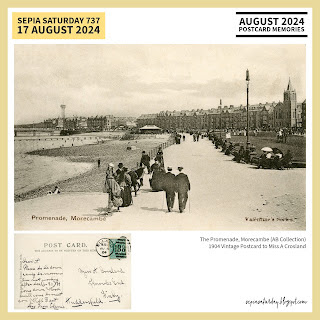
Sharing with Sepia Saturday. 

Friday, August 30, 2024

On the roads to new horizons


  I found this article from "Our State Magazine" in my "memories" folder on FaceBook. But it didn't include the "share" button. so I re-read the article, and wanted to be sure to share it somewhere, and hope to have it in my own archives here on Blogger. And if I shared it before (quite possibly) mea culpa!

Ramblin Man

The link still works for now at least.


My interest (as always) is in considering my ancestors who might have used these (or similar) roads.


In 1775, Daniel Boone "blazed" a trail for the Transylvania Company from Fort Chiswell in Virginia through the Cumberland Gap into central Kentucky. It was later lengthened, following Native American trails, to reach the Falls of the Ohio at Louisville. The Wilderness Road was steep, rough, narrow, and it could only be traversed on foot or horseback. Despite the adverse conditions, thousands of people used it.

Daniel Boone coming through Cumberland Gap by George Caleb Bingham


I've written about the Cumberland Gap, and my family's travels on the roads leading into Kentucky HERE.


The Williams family in Oklalla TX (maybe not related to my family) 1889

And here is a clip about an ancestress that lived into her 90s, who moved into Kentucky before it became a state. Here.


-------------------------

And a bit of Mary Oliver, just because...

"I thought the earth remembered me, she took me back so tenderly, arranging her dark skirts, her pockets full of lichens and seeds.

I slept as never before, a stone on the river bed,

nothing between me and the white fire of the stars
but my thoughts, and they floated light as moths
among the branches of the perfect trees.

All night I heard the small kingdoms breathing around me, the insects, and the birds who do their work in the darkness.

All night I rose and fell, as if in water, grappling with a luminous doom. By morning
I had vanished at least a dozen times into something better."

~Mary Oliver, "Sleeping in the Forest"


Sharing with  Sepia Saturday 


Wednesday, August 21, 2024

The ones who were here first

𝐒𝐚𝐜𝐚𝐣𝐚𝐰𝐞𝐚 (pronounced Sack-ah-jah-WEE-a),Indigenous American heroine.

Before Idaho was even a territory, Sacajawea was born in the Lemhi River Valley in the late 1780s. The Lemhi River Valley during this period was inhabited by the Agaidika
(Salmon-eater) Shoshone. Around the age of 12, Sacajawea was with her tribe hunting bison in the Three Forks area of the Missouri River when she was captured by a raiding party from another tribe. She was later traded to the Hidatsa tribe in present day North Dakota. She learned to speak the language of the Hidatsa and lived with the tribe for a few years. Once more she was traded, this time to French trapper Toussaint Charbonneau, and married him.
In the winter of 1805 while the Lewis and Clark Expedition wintered at Fort Mandan, Charbonneau, and subsequently Sacajawea, were hired to help the expedition on its westward journey. During the winter Sacajawea gave birth to her son, Jean Baptiste Charbonneau. In May of that year, Sacajawea and her infant child set forth as part of the Expedition west.
On August 12th, 1805, Meriwether Lewis and his men climbed the eastern slopes of the continental divide, and stood on what is now known as Lemhi Pass, viewing the birthplace of Sacajawea below to the west. Just five days later, Clark noted the reuniting of Sacajawea, her people, and her brother who was now a chief of the Agaidika.
Sacajawea provided lifesaving information regarding local tribes, edible foods, indigenous medicines, and the mostly unknown Idaho and Montana landscapes. Her ability to interpret and her relation to the tribes helped the Expedition acquire horses and supplies from the Agaidika people to continue on their journey west when supplies and spirits were low.
Today the Salmon Field Office administers to many of the lands formerly occupied by the Agaidika. Salmon landmarks such as the Sacajawea Center, and birthplace monument honor her and her people’s contributions to American History. (Post on FB by Margaret Russ)


-------------------

Posted Sun. Aug. 18, 2024 on FB from North Carolina Public Radio


"This fall, Duke University will offer a new online Cherokee language course series.
It's open to all students, and will count toward a full language college credit to graduate. Courtney Lewis, the university’s inaugural director for the Native American Studies Initiative, said this will also be the first time that Duke students will get to learn an American Indian language.

“So, one of the first things that students are going to learn how to speak about is their feelings,” she said. “And, that tells us a lot about the Cherokee language and the Cherokee people, right off the bat. So, students are going to also learn about concepts like Gadugi and Duyuk’dv’i, which are two of the guiding life principles for the Anigaduwagi people.”

The new course will also recognize the intertwined history of Duke University and American Indian education. From 1882 to 1887, Trinity College — now known as Duke University — ran a federally funded Cherokee Industrial Indian Boarding School with 20 Eastern Band of Cherokee Indian children.

“They were forced into a school whose sole purpose was to kill the Indian and save the man, as the quote went,” said Lewis. “So, their hair was cut, and their clothes were changed. They now played in marching bands. And, most importantly, they were not allowed to speak their language.”

The new Cherokee Language class is a four-course series. It’s supported by the partnership for less commonly taught languages through the cultural anthropology department at Duke. Students at Vanderbilt University will join this year's fall class at Duke online. Lewis said in the future, she hopes the course can be offered in person.

Photo shared by Native Americans Facebook site


A copper earring unearthed by First Colony Foundation archaeologists at Roanoke Island’s Elizabethan Gardens was almost certainly traded – or gifted – to local Native Americans by Sir Walter Raleigh’s explorers, based on scientific tests released this week.

An analysis conducted by Madison Accelerator Laboratory at James Madison University in Harrisonburg, Va., found that copper used to make the ring was of European origin, rather than from a North American source. This is significant because neither the French nor the Spanish – England’s rivals in exploring and settling the “New World” — ventured as far north as Roanoke Island to trade.

“This is an amazing find – with an intriguing story to tell.” said Eric Klingelhofer, First Colony Foundation’s vice president for research, who led the Elizabethan Gardens dig. “After laying hidden in the ground for more than four centuries, this piece of copper now confirms that we have indeed located the site of Roanoac, the Algonquian village that welcomed the first English explorers in 1584.”

Published by Outer Banks Voice


Friday, August 16, 2024

The August birthday family

 We start on the 12th, with Kendra, my daughter-in-law, wife of my youngest son Tai. She just turned... 47 years young.


On Aug. 16 my middle son was born, Russ Heym - he's going to be 57 years young.

Russ and myself at my apartment in St. Augustine, around 1997. 


Oh, he's sporting a greying goatee, so let's update his portrait - with Michelle, his wife at a soccer game in 2023.


Then Barbara Baker, another daughter-in law (wife of my son Marty) will have her birthday on Aug. 22 bringing her to great 61 years young!


A very good baker she has used this skill to establish a business out of her kitchen, selling gourmet Macarons at local conventions and shows in the Tampa-St. Petersburg area.


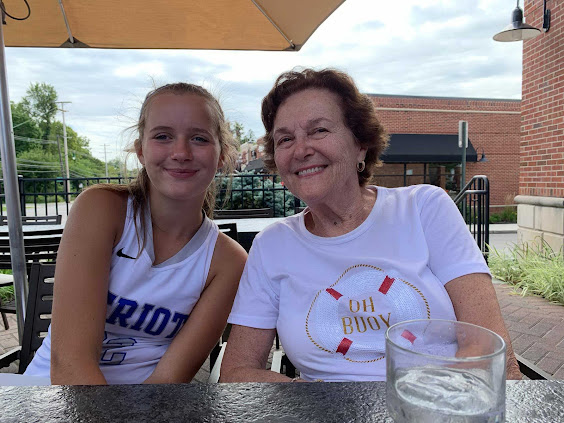
Next birthday is mine, August 23, and this year I complete my 82nd turn around the sun.


Sitting at the Tailgate Market each Saturday morning (well almost) in Black Mountain NC.

And the last August relative's birthday is my dear mother-in-law-sister, namely Joanne Naglieri, mother of Russ' wife Michelle Heym. Joanne's birthday is on Aug. 28, and this year she turns the big 85...which she certainly has not one hint of looking.

Joanne and Kate, our youngest granddaughter, taken in 2021.

I'm so glad to be bunched in with these wonderful Leos and Virgos...and getting ready for some other relative's birthdays in September. What's a grandmother/mother to do? Get the coolest cards I can find for everyone! 

I am skipping Hallmark these days! 

A bit of nursery rhymes on a "card" join my son Tai from his wife Kendra's birthday.


Sharing with Sepia Saturday!


Today's quote:

This universe is much too big to hold onto, but it is the perfect size for letting go.

SHARON SALZBERG


Friday, August 9, 2024

The immigrants


A photo from the River Thames, with caption by an Englishman.

44,000 convicts were sent to out to our American colonies during the 1700s until the American Revolutionary War (1775-83). These hulks in the River Thames photo in 1856 held 400-500 prisoners awaiting transport.

Not clear where they were sent in America.

And a map of early Virginia with King Powhatan. The Europeans who came to Virginia settled there, learned about raising tobacco, and started an entire industry bringing it back to Europe.

Sorry it's so small, so there's no clarity, unless you enlarge it.


Many well known descendants of these immigrants to the Massachusetts colony.


All of us descend from some immigrants, unless we're Native Americans!


And a very interesting post by fellow blogger that included a visit to Jamestown, with info from some of the historic sites. Millie Fiori Favoriti

Sharing with Sepia Saturday this week.


Today's quote:

It is a truism that almost any sect, cult, or religion will legislate its creed into law if it acquires the political power to do so.
 -Robert A. Heinlein, science-fiction author (1907-1988)

Friday, August 2, 2024

Hunting or enjoying the great outdoors

  Continuing the outdoor adventures for my parents and grandparents, started last week, here we have the Rogers clan going out hunting, or camping or just enjoying the great outdoors..


For Sepia Saturday, a post card from a park is the suggested meme.


My parents went to a park in Texas...Garner State Park, which is near San Antonio TX, where the Rogers were living by 1935. 

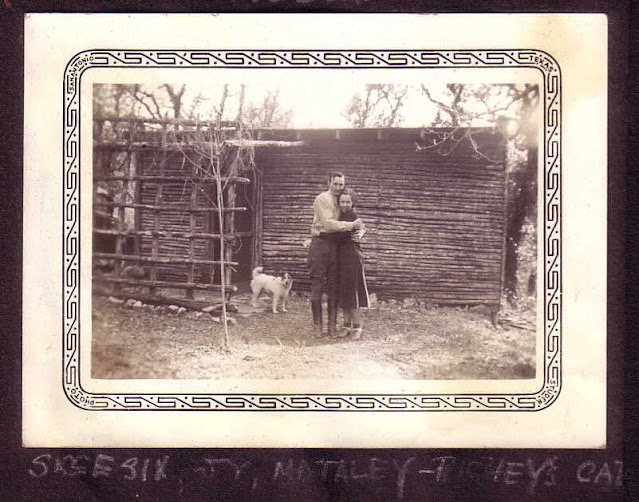
The Rogers family at that time consisted of George Sr., wife Ada, and 4 sons, Alex, Chauncey, James and George Jr. George Jr. was to become my father. My mother was with the Rogers on one of their trips before her marriage, and her name was Mataley Munhall.

4.21.35 my Uncle  Chauncey and my father in background with a lot of hair! and a tie? And I can't find where I got that date for this photo either!

My dad taking a slightly elevated nap, Garner State Park, 1937


The Civilian Conservation Corp camp, Garner State Park, Sept. 1937. As far as I know, none of my father's brothers (early 20s and younger) took part in the CCC.


My parents in 1937 in San Antonio TX


Skeezix, the dog, my father and mother apparently had fallen in love by then. Richey's Cabin.


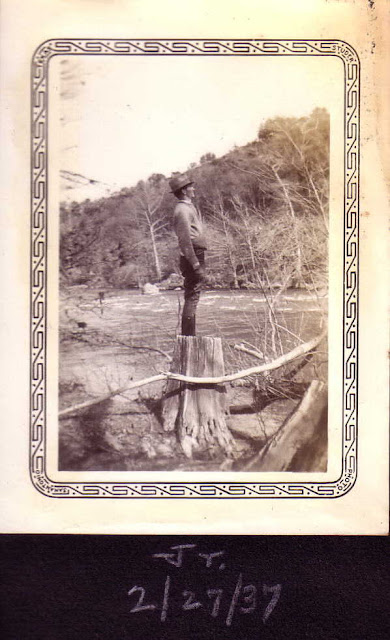
At Richie's cabin, Feb. 27, 1937. My parents with guns, for hunting I imagine.


George (my father) by a river

In 1918 (my cousin Patricia Rogers has documented) my grandparents moved from Galveston TX to   Meadowbrook Drive in Fort Worth, Texas, where he was employed by the Fort Worth Packing Company as office manager. This began a friendship with the company Manager, Norman Dumble that lasted twenty-five years


"George Jr. hit a deer." (Dumble Ranch) (that's the caption that is included with this photo on Ancestry)
I assume he shot the deer. But there he is in a tie again, which fortunately he didn't wear on the camping trip in Feb. 1937 with my mother. I don't know the date of this photo, nor the gentleman standing behind him, nor the young man. Isn't it interesting to see all the bugs on the front of the car?


George Rogers Jr (my father) at Dumble's Ranch, 12/26/36


Today's quote:

The influence of each human being on others in this life is a kind of immortality. 
-John Quincy Adams, 6th president of the US (1767-1848)